Bad smell inspection · Apartments, villas & townhouses
Bad Smell Inspection & Snagging in Dubai
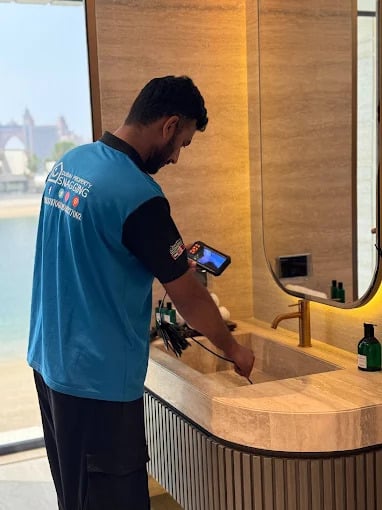
Sewage in the bathroom, a musty smell from the AC, a damp odour behind the wardrobe: air fresheners only hide it. Our engineers trace the smell to its source with drain checks, a borescope camera, thermal imaging and humidity readings, then give you a photo report with the cause and the recommended fix.
- Source traced and photographed, not guessed
- Non-destructive: no tiles lifted, no walls opened
- New handover, resale and rented properties
- Report you can send to your developer or landlord
Gas smell in your home?
Is it a gas smell or a sewer smell?
In Dubai homes, a rotten-egg or gas-like smell very often turns out to be sewer gas coming up from the drains, not cooking gas. Sewer gas contains hydrogen sulphide, and cooking gas is given a similar smell on purpose, so the two are easy to confuse.
Usually sewer gas (drains) if…
- It is strongest in the bathroom, near a floor drain or the toilet
- It appears in rooms you rarely use, or after you were away
- It fades for a while after you run water down the drains
- It gets worse when the AC or exhaust fan is running
Could be cooking gas if…
- It is strongest at the cooker, gas meter or gas pipe
- It does not change when you run water down the drains
- It started after a cylinder change or work on the gas line
If you suspect cooking gas: close the gas valve, open the windows and ask your building's gas supplier to check the line first. Once the gas line is confirmed fine, we trace the smell everywhere else.
Why it happens
Why so many Dubai homes have a bad smell
Most odours in Dubai properties come from three things: drainage, the AC system and hidden moisture. The climate makes all three worse. In summer, the water that seals a drain trap can evaporate within weeks in an empty unit. AC systems run almost all year, producing condensate that has to drain away properly. Warm, humid air meeting cold ducts and walls creates the damp conditions mould likes.
New buildings add their own problems: cement and grout left in floor drains, missing seals under toilets, AC drain lines connected to the wrong pipe, and exhaust fans that blow into the ceiling void instead of outside. These are installation defects. Found before handover or within the defects liability period, they are usually the developer's to correct.
A bad smell inspection starts from where and when you notice the smell, then tests every possible path until the source is found and photographed.
Smell guide
What does the smell in your home mean?
The type of smell is the first clue. This is how our inspectors read it before any tool comes out.
| Smells like | Most likely source | Where we check |
|---|---|---|
| Sewage, rotten eggs | Sewer gas from a dry trap, a failed toilet seal or a drain with no water seal | Floor drains, WC base, basin and sink traps, washing machine drain |
| Musty, damp, earthy | Mould from AC condensation, a hidden leak or wet insulation | AC ducts and diffusers, fan coil unit, behind wardrobes, ceilings, below windows |
| Sewage only when the AC is on | AC condensate line tied into the drain without a trap | Fan coil unit, condensate pipe route, drain connection |
| Stagnant water, swampy | Standing water in the AC drain pan, or a blocked or back-falling drain | Fan coil drain pan, condensate line, shower and balcony drains |
| Rotten, dead animal | Pest or rodent in a ceiling void, shaft or duct | False ceilings, service shafts, kitchen cabinet voids |
| Stale, lingering cooking smell | Exhaust fans not working, too weak, or not ducted outside | Bathroom and kitchen extracts, airflow at the grilles |
| Paint, glue, chemical | New paint, adhesives, sealants and joinery off-gassing | Whole unit, especially closed rooms and new wardrobes |
| Gas-like, sulphur | Most often sewer gas. If strongest at the cooker, possibly cooking gas | All drains and traps first. The gas line is checked by your gas supplier |
| Burning, hot plastic, fishy near sockets Urgent | Overheating wiring, a loose connection or a failing fitting | Sockets, switches, light fittings, distribution board |
What we usually find
The most common causes of bad smells in Dubai properties
Eight sources account for almost every odour complaint we inspect. Each one is confirmed on site and photographed before it goes in your report.
Dry floor drains and traps
Every drain has a trap that holds water to block sewer gas. In unused bathrooms, maid's rooms, balconies and empty units, that water evaporates and the smell comes straight up. We confirm it by checking each trap for a water seal, refilling it and rechecking the room.
Failed or missing toilet seal
If the seal between the toilet pan and the drain is missing, badly fitted or has moved, sewer air escapes around the base. We confirm it by checking the pan for movement, inspecting the base and silicone joint, and scanning the floor for moisture.
AC condensate line with no trap
If the AC drain pipe joins the drainage without a trap, the fan draws drain air in and blows it around the home, often worse when the AC is on. We confirm it by following the condensate route from the access panel, with the borescope inside the ceiling.
Mould in the AC unit or ducts
A drain pan that does not empty, damaged duct insulation or condensation on cold ducts lets mould grow, causing the classic musty smell and dark spots around diffusers. We confirm it with borescope checks plus humidity and surface temperature readings.
Hidden leaks behind tiles and walls
A slow leak from a pipe joint, shower mixer or failed waterproofing keeps walls and screeds damp, and the smell often shows up in the next room. We confirm it with thermal imaging, humidity readings and tile tapping, without breaking anything.
Construction debris in drains
Cement, grout and tile waste washed into drains during fit-out leave standing water that turns stagnant. It is one of the most frequent snags in new units. We confirm it by putting the borescope inside the drain and photographing the blockage.
Exhaust fans that do not extract
A fan can be noisy and still move almost no air, or be ducted into the false ceiling instead of outside, so moisture and odours stay in the room. We confirm it by measuring air speed at the grille and checking the duct through the access panel.
Shafts and neighbouring units
Gaps around pipes passing through walls and shafts let odours travel from building risers or a neighbour's unit, so the smell has no source inside. We confirm it by checking penetrations, access panels and shaft doors for open gaps and missing sealant.
Inspection scope
What our bad smell inspection covers
We check every path an odour can take into your home, then focus on the rooms where you notice it most.
- Floor drains, gullies and balcony drains
- Basin, sink, shower and bath traps
- Toilet pan fixing, base seal and silicone
- Washing machine and dishwasher drain points
- AC fan coil unit, drain pan and condensate line
- AC ducts, diffusers and return grilles
- Bathroom and kitchen exhaust fan airflow
- Thermal scan of walls, ceilings and floors for damp
- Room-by-room humidity and temperature readings
- Hollow tile and wet area checks in bathrooms
- Pipe penetrations, shaft and access panel gaps
- False ceiling voids via access panels
- Visible mould, staining and water marks
- Electrical hot spots where a burning smell is reported
The tools behind the report: thermal imaging camera, borescope inspection camera, thermo-hygrometer, infrared thermometer, anemometer and hollow tile stick, with LED lighting for ceiling voids. Our inspectors are trained on this equipment by Gazelle's technical team. See every tool we use.
Our process
How we trace a bad smell, step by step
Nothing is drilled, lifted or opened at any stage.
- 01
We ask before we test
Which rooms, what kind of smell, what time of day, and whether it is worse with the AC on, after a shower or after rain. These answers narrow the search before we arrive.
- 02
Room-by-room walk-through
The inspector walks every room with doors and windows closed, then with the AC and exhaust fans running, and marks where the smell is strongest.
- 03
Drains and traps
Every trap is checked for a water seal. Floor drains and gullies are inspected with the borescope for blockages, debris and missing parts.
- 04
AC system
Through the access panel we check the fan coil unit, drain pan, condensate pipe and duct insulation, and measure the air at the diffusers.
- 05
Hidden moisture
A thermal scan of walls, ceilings and floors finds damp areas, and humidity readings confirm them.
- 06
Ventilation and gaps
Exhaust airflow is measured, and pipe penetrations and shaft openings are checked for gaps that let odours in from outside the unit.
- 07
Your report
A digital report with photos, thermal images and readings, showing the likely source, why it causes the smell and the recommended repair. Send it straight to your developer, landlord or maintenance company.
Who it's for
For owners, buyers and tenants
The same inspection, used at different moments in the life of a property.
Before handover
Add odour checks to your snagging inspection. Dry traps, debris in drains and untrapped AC drains go on the snag list, so the developer fixes them before you move in.
Recently handed over
Smell started after you moved in? A report with photos and readings gives you clear evidence to raise with the developer while the defects liability period is running.
Buying a resale
Fresh paint and an air freshener can hide a leak or mould. Checking before you sign tells you what you are buying and what it may cost to fix.
Tenants and landlords
An independent report shows where the smell comes from and what repair it needs, so the right party arranges it without arguments over the cause.
Try this first
Simple checks you can do before you book
Some smells have a simple cause. If these steps do not solve it within a day or two, the problem is likely an installation defect or a hidden leak.
| Check | How to do it | What it tells you |
|---|---|---|
| Run water in every drain | Pour a jug of water into each floor drain and run every basin, shower and bath you rarely use | If the smell goes, a dry trap was the cause. Repeat weekly in unused rooms and while you travel |
| Note when it smells | Write down whether it is only with the AC on, after a shower or in the morning | Points to the AC, drainage or ventilation, and saves time on the day |
| Look under the sinks | Open the cabinets and check the pipework | A missing U-bend, a loose joint or water in the cabinet |
| Look at the AC diffusers | Check the ceiling grilles and the ceiling around them | Dark spots, dripping or stains point to condensation or a drain pan problem |
| Test the exhaust fan | Hold a sheet of tissue paper near the grille | If it is not pulled towards the fan, the fan is not extracting enough air |
Do not pour strong chemicals into drains to mask a smell. It can damage seals and pipes, and it hides the evidence of a defect that should be corrected properly.
Clear about our role
What is included, and what is not
We are independent inspectors. Being clear about our limits is what makes our reports trusted by developers and landlords.
| Area | Included | Not included |
|---|---|---|
| Repairs | Likely source and the type of repair needed | We inspect and report. We never carry out repairs |
| Mould | Visible mould, humidity, condensation and hidden damp, with photos and readings | Laboratory mould-spore or air-quality testing |
| Access | Drains, access panels, shaft doors and existing openings | Opening walls, lifting tiles or cutting sealed ceilings |
| Gas line | Every drain and trap that can cause a gas-like smell | Testing the cooking gas line, which is your gas supplier's job |
If the source points to a problem that needs specialist testing, the report says so and explains which specialist is needed.
Questions
Bad smell inspection in Dubai: FAQs
Why does my bathroom smell like sewage in Dubai?
The most common cause is a dry trap. Floor drains and rarely used basins or showers lose their water seal through evaporation, which lets sewer gas into the room. Other causes are a failed toilet base seal, debris in the drain or a drain installed without a trap. Pour water into every drain first. If the smell returns, the cause is likely an installation defect that needs an inspection.
Why does my apartment smell like gas?
In most Dubai homes, a gas-like or rotten-egg smell is sewer gas from a drain, not cooking gas. It usually comes from a dry floor drain, a basin or shower that is rarely used, a failed toilet seal or an AC drain line without a trap. If the smell is strongest at the cooker or gas meter, close the gas valve and ask your gas supplier to check the line first. For everything else, our inspection traces the source and documents it with photos.
Why does my AC smell bad?
A musty AC smell usually means mould or standing water in the fan coil unit, drain pan or ducts. A sewage smell that appears when the AC runs often means the condensate pipe is connected to the drainage without a trap, so the AC draws drain air into the home. Both can be traced by checking the unit and condensate route through the access panel.
Can you find the source of a smell without breaking tiles or walls?
Yes, in most cases. The inspection is non-destructive. We use drain checks, a borescope camera through existing openings, thermal imaging and humidity readings. If a source is behind a finish and cannot be confirmed without opening it, the report shows where the evidence points so the repair can be targeted and kept small.
Is a bad smell a snagging defect the developer should fix?
Often, yes. Missing or faulty traps, toilets without a proper seal, construction debris in drains, untrapped AC condensate lines and exhaust fans not ducted outside are installation defects. Reported before handover or within the defects liability period, they are normally the developer's responsibility to correct. Our report gives you the photos and readings to support the request.
How long does a bad smell inspection take?
It depends on the size of the property and how many areas are affected. A targeted inspection of an apartment usually takes a few hours on site. When the smell check is part of a full snagging inspection, it is done during the same visit.
Should I do the inspection with the AC on or off?
Both. We check rooms with the AC off and then with it running, because some smells only appear when the AC fan pulls air through a faulty drain line or a contaminated duct. Please tell us when you notice the smell most so we can recreate those conditions.
Do you test for mould?
We look for visible mould and the conditions that cause it, such as high humidity, condensation and hidden damp, and we record them with photos and readings. We do not take laboratory air or spore samples. If the findings suggest you need lab testing, the report will say so.
My apartment smells of paint and chemicals after handover. Is that normal?
A paint or glue smell is common in new homes for the first weeks, as fresh paint, adhesives, sealants and new joinery release fumes. Keep the property ventilated and the AC running. If it does not fade or comes with damp marks, have it checked, as a damp smell can be mistaken for a new-home smell.
The smell comes from my neighbour's unit or the corridor. Can you check that?
We inspect inside your property and the access points you can open, such as shaft doors and access panels. We can show where odours enter your unit, for example through gaps around pipes or open penetrations, and the report can then be shared with the building management to inspect the shared areas.
Do you also repair the problem?
No. We are independent inspectors and do not carry out repairs. This keeps our findings unbiased. The report explains the likely source and the type of repair needed, so your developer, landlord or contractor can fix it.
Why does my apartment smell bad after I come back from holiday?
While a property is empty, the water in drain traps evaporates, especially in the Dubai summer. Without that water seal, sewer gas comes up through floor drains, basins and showers. Run water in every drain when you return, and ask someone to do it weekly while you are away. If the smell stays after the traps are refilled, there is likely another cause that needs to be traced.
Why does the smell come and go?
A smell that comes and goes usually depends on air pressure or use. Exhaust fans, the AC and wind can pull air through a weak trap or a gap around a pipe, and a trap can be emptied when a neighbouring drain is used. Tell us when you notice it most, and we recreate those conditions during the inspection.
Why does my washing machine area or laundry smell?
The washing machine waste pipe is often pushed into a drain point or standpipe with no proper trap or seal, which lets drain air into the room. Dirty water left standing in the machine or its filter can also smell. We check how the drain point is connected and whether it has a working water seal.
Why does my kitchen sink smell even after cleaning?
Common causes are a dry or badly fitted trap, a dishwasher drain hose connected without a high loop or non-return valve, grease build-up in the waste pipe, or a leak in the cabinet under the sink. We check the trap, the connections and the cabinet for moisture.
Can a hidden water leak cause a bad smell?
Yes. A slow leak keeps walls, screeds and ceilings damp, and damp materials develop a musty smell and mould, often in a different room from the leak itself. Thermal imaging and humidity readings help find wet areas without breaking tiles or walls.
Is sewer gas harmful?
Sewer gas contains hydrogen sulphide and other gases. At the low levels usually found in homes, it mainly causes an unpleasant smell, and some people report headaches or nausea. It should not be ignored, because it means the drainage is not sealed properly. If anyone in the home feels unwell, ventilate the property and speak to a doctor.
Can mould from the AC affect my health?
Mould and damp can trigger allergy or asthma symptoms in sensitive people. We are not medical professionals, so we do not give health advice, but our report shows where mould and damp conditions are present so they can be cleaned and the cause corrected.
Do you inspect villas and townhouses as well as apartments?
Yes. In villas and townhouses we check every bathroom, the kitchen, laundry, maid's room and balconies, plus the AC units and accessible roof and terrace drains. Larger homes have more drains that are rarely used, so dry traps are especially common.
How should I prepare for a bad smell inspection?
Please do not pour chemicals or air freshener into the drains before the visit, as it can hide the source. Keep the AC running as normal, make sure we can reach all rooms and ceiling access panels, and note when and where you notice the smell most. It helps if you or someone who knows the property is there at the start.
How quickly will I receive the report?
You receive a digital report with photos, thermal images and readings, normally within 6 hours of the inspection. You can forward it directly to your developer, landlord or maintenance company.
How much does a bad smell inspection cost?
The price depends on the property type, its size and whether the smell check is done on its own or as part of a full snagging inspection. Send us your property details on WhatsApp and we will give you a clear quote before booking.
Stop masking the smell. Find the source.
Drains, AC, hidden leaks and ventilation, checked by certified engineers and documented in a photo report you can send straight to your developer or landlord. We inspect, we never repair.
DED Certified · RERA Approved · InterNACHI Certified · 98,000+ Inspections