Villas · Townhouses · Penthouses · Rooftop Terraces
Roof & Terrace Leak Inspection in Dubai
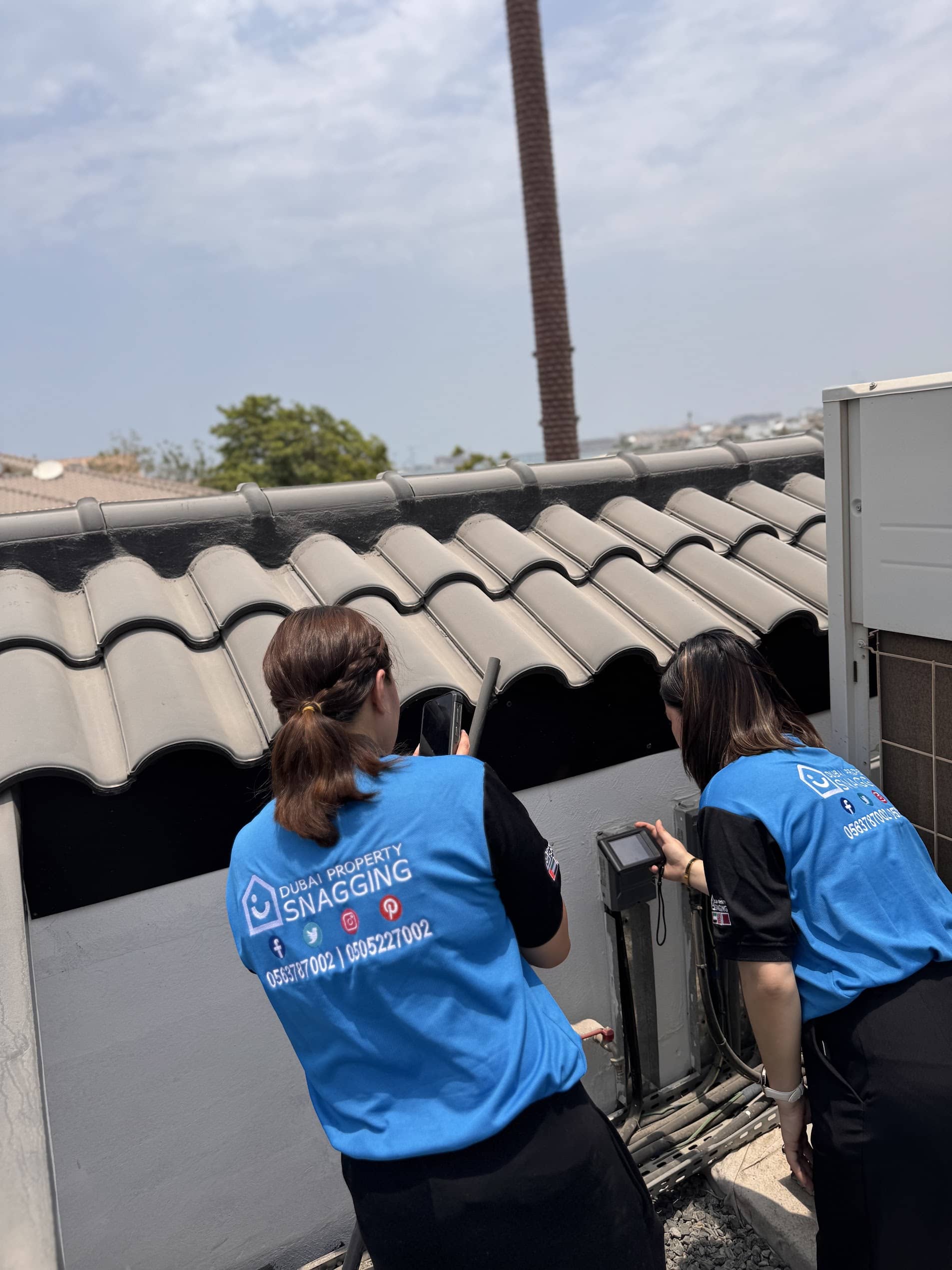
Dubai does not rain often, and that is exactly why roof leaks catch owners out. A waterproofing defect can sit unnoticed for months, then show up overnight as water through a ceiling, a light fitting or a wall the first time heavy rain arrives. Our certified engineers find where the water is getting in, test the waterproofing, and document every defect in a photographic report within 6 hours.
Why it happens in Dubai
Why Dubai Roofs Fail When You Least Expect It
Most roofs and terraces in Dubai are flat. Instead of shedding water down a slope, they rely on three things working together: a continuous waterproofing membrane, a screed laid to falls, and drain outlets that carry water away quickly. If any one of them is wrong, water sits on the roof and searches for the weakest point.
In summer the roof surface gets far hotter than the air, then cools sharply at night. That daily expansion and contraction cracks screed, opens joints, lifts tiles and pulls sealant away from walls. UV light breaks down exposed membranes and mastic, and wind-blown sand collects in outlets until they block.
Then, a few days a year, it rains hard. The April 2024 storms showed many Dubai homeowners that their roofs had been failing for years. Water that cannot drain ponds on the roof, rises above the membrane upstand and runs into the structure.
A roofer will usually reseal what is visible. We find where the water actually enters, how far it has travelled inside the building, and whether the waterproofing system as a whole is still sound, so you know if you need a local repair or a new membrane.
How a flat roof works
Six Places Water Gets Into a Flat Roof
A typical Dubai villa roof, and the details we check on every inspection.
- 1 · Parapet & upstand A membrane not turned up high enough, or cracked coping and render, lets water run behind the waterproofing.
- 2 · Tiles & screed Cracked screed and open grout joints let water reach the membrane faster and hold it there.
- 3 · Drain outlet Blocked grates, missing clamping rings or a poorly sealed collar are the most common single leak point.
- 4 · Penetrations AC pipes, cable sleeves, plinths, railings and solar mounts all break the membrane and need sealing.
- 5 · Membrane Torn laps, blisters, UV damage or punctures from later works fail out of sight beneath the finish.
- 6 · Ponding Screed laid without enough fall leaves standing water that eventually finds the weakest point.
Warning signs
Signs Your Roof or Terrace Is Leaking
Note when the symptoms appear. The timing is one of the best clues to the source.
Ceiling stains after rain or washing
Marks that appear or grow after rain, after the terrace is washed down, or after a roof garden is irrigated.
Water through light fittings
Water collects on the ceiling board and escapes through the nearest opening, usually a downlight or AC grille.
Damp patches on top-floor walls
Water running behind the parapet or under a terrace door threshold shows up on the walls and skirting below.
Standing water on the roof
Puddles that remain hours after rain mean the falls or the drain outlets are not doing their job.
Cracked tiles and failed sealant
Visible surface damage usually means the layers underneath are under the same stress.
Peeling paint and white salts
Bubbling paint and white efflorescence on parapets and walls show water moving through the masonry.
Root causes
The Roof and Terrace Defects We Find Most Often
| Defect | What causes it | Where it usually shows |
|---|---|---|
| Blocked roof drains | Sand, leaves and debris collect in outlets and gutters, so water backs up across the roof. | Ponding; overflow at door thresholds |
| Poor drain collar sealing | Membrane not clamped or bonded into the outlet, leaving gaps around the pipe. | Ceiling directly below the outlet |
| Low or missing upstands | Membrane stops at floor level instead of rising up parapets, walls and thresholds. | Wall-to-ceiling junctions; below doors |
| Inadequate falls | Screed laid flat or with low spots that hold water after every rain. | Wide, slow-growing stains |
| Unsealed penetrations | AC pipes, conduits and fixings drilled through after the waterproofing was laid. | Along pipe routes in rooms below |
| Membrane damage | Membrane punctured during tiling, fit-out or installation of rooftop equipment. | Often far from the actual cause |
| Thermal cracking | Daily heating and cooling cracks screed, coping and render and opens movement joints. | Parapets, roof edges, expansion joints |
| Failed terrace thresholds | Door frame set too low, or no step-up and sill seal tied into the waterproofing. | Floors and skirting inside the door |
Scope of inspection
What Our Roof & Terrace Leak Inspection Covers
We inspect the roof or terrace above and the rooms below, because the evidence is split between the two.
Villa & Townhouse Roofs
- Membrane, screed and tiling condition across the roof
- Drain outlets, gutters, scuppers and rainwater pipes
- Parapet walls, copings and membrane upstands
- AC plinths, pipe and cable penetrations
- Skylights, roof hatches and staircase bulkheads
- Pergola, shade structure and solar panel fixings
- Ceilings and walls of the top-floor rooms below
Terraces, Balconies & Penthouses
- Terrace tiles, grout, movement joints and falls
- Sliding door thresholds and sill sealing
- Floor drains and linear drainage channels
- Planters and roof garden waterproofing
- Jacuzzi, plunge pool and water feature edges
- Railing and glass balustrade fixings
- The ceiling of the apartment or room below
How we test
Finding the Leak Without Stripping the Roof
We isolate one detail at a time until the entry point is proven.
Flood test
The roof or terrace is sealed and flooded to a set depth for 24 to 48 hours while we monitor the ceilings below.
FLIR thermal imaging
Scans of the roof surface, ceilings and walls reveal wet areas and moisture trapped inside the roof build-up.
Moisture mapping
Meter readings across ceilings, walls and screed show exactly how far the water has spread inside the building.
Drain flow test
Water is run into each outlet and timed to discharge, exposing blockages, poor falls and leaking collars.
Targeted water test
A controlled hose test on one detail at a time, such as a threshold or a pipe penetration, isolates the leak point.
Detail survey
Upstands, laps, sealants, copings and penetrations are inspected and photographed one by one.
What happens next
Local Repair or New Waterproofing?
The question that decides your repair cost, answered with evidence.
A local repair is usually enough when
- The leak is traced to one detail, such as an outlet collar, a penetration or a threshold
- The rest of the roof passes the flood test
- The membrane is still flexible and well bonded
- The falls drain water properly after rain
Full re-waterproofing is usually needed when
- Water enters at several points across the roof
- The membrane is brittle, blistered or UV-damaged
- Ponding shows the falls are wrong across large areas
- Previous patch repairs have already failed
The process
From Booking to a Clear Answer
- 1
Book and send photos
Share pictures of the stain and of the roof or terrace above it on WhatsApp. We confirm the scope and whether a flood test is needed.
- 2
Clear access
Make sure we can reach the roof or terrace and the rooms below, and move loose items away from the drains.
- 3
On-site inspection and testing
Our engineer surveys the roof, tests the drains and scans the rooms below. Flood tests are set up and left running.
- 4
Report within 6 hours
A Spectora report with thermal images, moisture readings, the confirmed leak points and our recommendation: local repair or full re-waterproofing.
- 5
Re-test after repair
We return to flood test the repaired area before tiles are relaid or the ceilings below are repainted.
When to book
Who Needs a Roof Leak Inspection
We inspect. We never repair. We do not sell waterproofing, membranes or roofing work, so nothing in our report is a sales pitch. When we say a roof needs a local repair rather than a new membrane, there is no commission behind that advice. You get an independent report to give to your developer, maintenance company or any waterproofing contractor you choose.
Related services
When the Water Is Coming From Somewhere Else
Not every top-floor leak starts on the roof.
FAQs
Roof and Terrace Leak Questions, Answered
Why does my roof only leak when it rains heavily?
Light rain drains or evaporates before it reaches a defect. Heavy rain overwhelms blocked outlets and poor falls, so water ponds and rises above upstands, thresholds and membrane laps it would never normally reach.
How do you find a roof leak without removing the tiles?
We combine a detail survey, thermal imaging, moisture mapping, drain testing and targeted water tests. In most cases this pinpoints the leak area without lifting a tile.
What is a flood test and how long does it take?
A flood test seals a roof or terrace and fills it with water to a set depth, usually for 24 to 48 hours, while the ceilings below are checked for leaks. It is the most reliable way to prove whether a waterproofing system holds water.
Can a roof leak appear far from where the water gets in?
Yes, very often. Water can run along the slab, through the insulation or along pipes for several metres before it appears. That is why patching the ceiling directly under the stain rarely solves the problem.
Is the developer responsible for my leaking roof?
If your property is still within its defect liability period, waterproofing and drainage defects are normally the developer's responsibility. Our report gives you the evidence you need to raise a claim.
Who is responsible for a leaking terrace in an apartment building?
It depends on whether the terrace belongs to your unit or is a common area, and on the building's rules. An independent inspection identifies the source, so the owner, the owners' association or building management can agree who should repair it.
Do you repair roof leaks or apply waterproofing?
No. We are an independent inspection company and never carry out repairs. That keeps our advice impartial, and you are free to use our report with any contractor you choose.
How long does a roof leak inspection take?
A villa roof and the rooms below usually take two to three hours. If a flood test is needed, we set it up on the first visit and return to check it. Your report is delivered within 6 hours of the inspection.
Find the Leak Before the Next Rain
Book an independent roof and terrace leak inspection anywhere in Dubai and the UAE. Certified engineers, flood testing and thermal imaging, with a full report within 6 hours.
DED Licensed · RERA Approved · InterNACHI Certified · 98,000+ Inspections