Understanding the differences between a villa and a townhouse are essential when it comes to purchasing a property in Dubai. Both villas and townhouses can deliver a similar experience for family living and private outdoor space. They also offer private community facilities, but they differ in layout, privacy, and maintenance responsibilities. Areas to focus on during a property inspection vary by home type. Focus also differs for villas, townhouses, new builds, and existing properties. Privately owned areas affect the inspection scope. For buyers the choice should not solely be based on the layout and prices. The property may seem appealing at an agent’s viewing. It can have defects, drainage flaws, or installations that require fixing. Property Snagging Dubai services and snagging can assist prospective owners. They help identify the state of a home before handover.
What Is the Difference Between a Villa and a Townhouse?
A villa is generally a stand-alone residential property, although some developments also cater to semi-detached villas. A villa provides greater separation from other residential properties. It offers its own private outdoor area and, potentially, a private garden, garage, terrace, and swimming pool.
People typically find a townhouse in a row of homes. It shares one or more side walls with other properties. These homes can have multiple levels. It includes a small private garden. They offer access to shared community facilities such as parks and swimming pools.
The design varies by development. Therefore, review the property’s plans and specifications to ensure they align with expectations. Do not assume all villas or townhouses share the same features.
In conclusion, both town homes and villas can offer a family-friendly living environment. The town homes typically provide more freedom regarding distance from other projects. The villas may offer more room.
Space, Privacy and Everyday Living
The amount of space is typically a factor that buyers use to decide between a villa and a townhouse. Villas offer greater space on a plot. This allows a buyer to host more private outdoor gatherings and enjoy a private garden. Some also provide additional storage, utility areas or a home office.
A townhouse can be more practical due to the space available. It includes multiple levels and a family-friendly layout. In some instances townhouses can provide buyers with family living accommodation without the responsibilities that come with a larger plot.
Privacy is another consideration that differentiates the two types of properties. While a detached villa will not share a common side wall with another property, a town house commonly does. This means that the arrangement of windows can differ. The location of the terrace or garden may differ, and the overall impact of the property can vary.
During a viewing, it is important to think about how one’s everyday schedule will accommodate the layout of the property. Consider natural lighting, the property’s flow, storage, outdoor access, and room use. Do not rely solely on the buyer’s brochure appearance.
Maintenance Responsibilities Can Be Different
A villa can require greater maintenance. The property usually has exterior surfaces, boundary walls, garden areas, roof elements, and drainage features, compared with a townhouse. We must regularly maintain all these areas, which increases how many areas we must review.
When a villa has a private pool, there are additional equipment and maintenance responsibilities that come with it.
Townhouses have a smaller private outdoor area. The development’s community maintenance may maintain some external walling and fittings. However, buyers should not assume that the community automatically bears all defects or maintenance duties. These factors vary depending on the property documents, agreements, and the nature of the defect.
Before buying either property, identify areas privately owned or maintained. Then clarify which areas the community manages. Before purchasing either property, determine who privately owns or maintains each area and who manages them for the community. Read service-charge documents and the property’s documents, and determine who is responsible for external walls, roof, drainage, and structures.
These nuances are important. The physical difference between a villa and a townhouse influences the inspection scope and maintenance responsibilities for the property.
Why Property Inspection Matters For Both Homes
Whether a property is a villa or townhouse, a property inspection can help identify defects. A buyer may not be able to spot them during a viewing. A professional home inspection will evaluate accessible areas to identify common visible defects, workmanship, finishing, and accessible fixtures and systems.
For a new property, snagging typically focuses on workmanship and finishing. It also covers the operation of accessible fixtures and systems before handover or shortly after. For an existing property, the inspection scope grows with its condition. It also depends on the buyer’s concerns.
A qualified professional can inspect walls and ceilings, flooring, doors and windows, kitchen cabinets, bathrooms, plumbing, electrical accessories, and air conditioning. We should agree the inspection scope in advance and request a specialist inspection when necessary.
If a buyer is considering several properties, they should request the same transparency regarding the scope of inspection for each. This way, it will be easier to compare the results of a villa inspection and a townhouse inspection.
What to Check During a Villa Inspection
A villa inspection must ensure that the internal areas of the property are accessible, examine the available external areas as far as safe access. Aside from the internal and external finishes and systems, a buyer should pay extra attention to the roof or roof-accessible areas where safe access is possible, external walls, boundary walls, terraces, garages, and garden drainage.
Inspect visible cracks, damaged paintwork, loose or uneven tiles, signs of water ingress, and poorly finished joints. Doors and windows must be operational, and plumbing points accessible for the purposes of visible leaks. Air-conditioning should be operational through the available controls.
Drainage on the outside is something that deserves extra attention. Water should not accumulate unnecessarily on accessible paved areas, entrances, or other surfaces after typical drainage conditions. An appropriate professional should review any concerns about water flow, waterproofing, or concealed pipework.
A villa inspection is not just about identifying cosmetic imperfections. It is about recording concerns and having them appropriately clarified before any owner proceeds with handover.
What to Check During a Townhouse Inspection
A townhouse inspection has similar points as a villa inspection but additional considerations apply for a property that shares a common side wall with another. In terms of internal areas a buyer should inspect walls and ceilings, flooring, doors and windows, bathrooms, kitchen fittings, plumbing, electrical accessories, and air conditioning. They should examine areas for uneven finishes, damaged surfaces, loose fittings, or signs of moisture around windows and bathrooms.
The buyer should also pay attention to the areas around shared walls but should not assume that a mark or crack is due to the neighboring property. They should record the location and appearance of the concern, and request an appropriate assessment if it does not seem normal.
The buyer should also inspect the private garden, entrance, terrace, and accessible external drainage points where available. For townhouses that are part of a managed community, they should ensure which aspects are the homeowner’s responsibility and which are managed by the community management.
For either property, an inspection report should differentiate between observable defects and those that may require further investigation. This is useful when discussing repairs with a developer or seller.
Why Plinth Protection Should Not Be Overlooked
An external feature that may require attention during a property inspection is plinth protection. This is a protective surface or treatment provided around the base of a building according to its design. Protection is commonly provided to the area and materials near the base of the building to mitigate surface water and its deterioration.
During a visual external inspection, a buyer should examine visible damage, cracks, deterioration, or signs that water is collecting near the base of the walls. The buyer should also observe if adjacent paving or ground surfaces are directing water towards the building rather than away from it.
The presence and design of plinth protection varies between properties, so it should be examined in comparison to the relevant plans and specifications. A visual inspection cannot confirm concealed waterproofing or ensure that the system meets every technical requirement. If a buyer notices persistent dampness, water ingress, or damage around the building’s base, they should request further assessment from an appropriately qualified professional.
This is particularly relevant when comparing properties with different plots, landscaping, paving, and drainage, and should be part of the overall inspection rather than a consideration afterwards.
How a Snagging Company in Dubai Can Help
Selecting a reliable snagging company Dubai buyers can work with is a critical step when arranging a pre-handover inspection. A suitable provider should be able to explain the scope of the inspection, document the findings and identify concerns that may require a specialist’s attention.
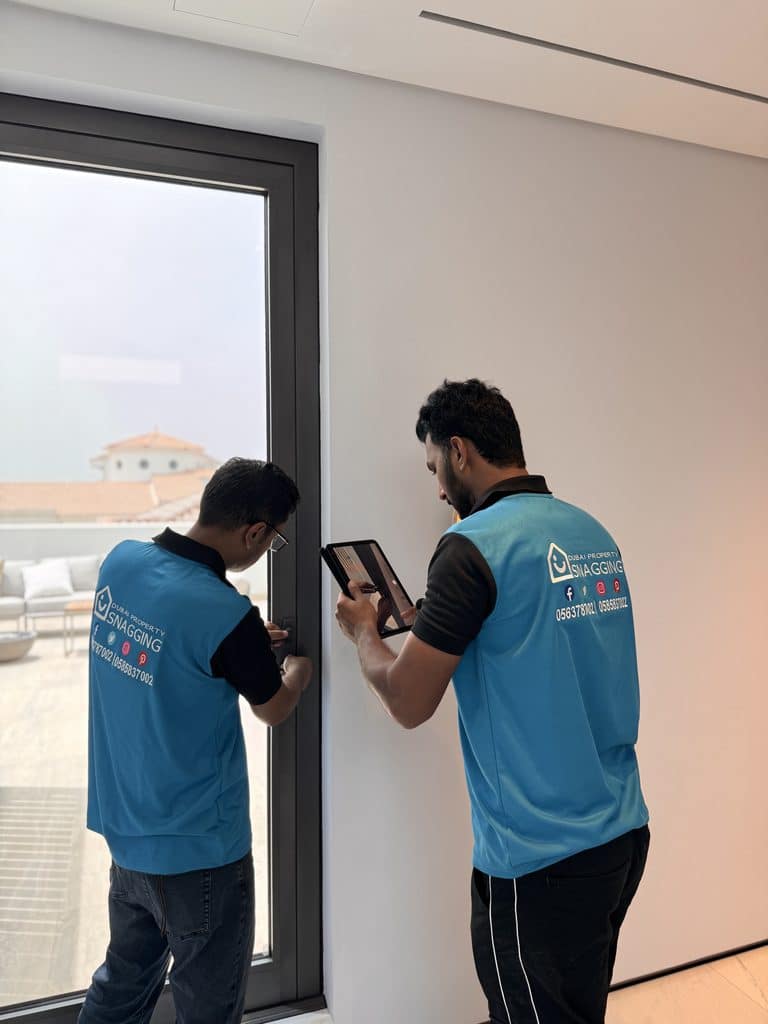
The professional should not simply walk through the property and document a variety of marks. The inspector should assess accessible areas in a systematic manner, test any suitable fixtures where safe, and present a report that assists the owner in understanding the location and nature of each finding.
When reviewing providers, an important question to ask is whether their service covers the property type under consideration, what equipment may be used, how photographs and findings are presented, and whether a follow-up inspection is available after rectification.
The best option is not necessarily the company providing the longest checklist or the lowest quote. The buyer should look for a clear scope of work, relevant experience, transparency in reporting, and an appropriate explanation of what is and is not included.
For buyers seeking property snagging Dubai services, these questions can help to establish whether the inspection aligns with their needs before handover.
Understanding Snagging Work and the Final Report
Once an inspection is complete, the findings should be presented in a useful manner. Effective snagging work will ensure that the location of a concern is identified, what was observed, and include appropriate photographs where necessary.
For example, a report may identify a damaged tile in the ground-floor bathroom, a window that does not close smoothly, or visible deterioration around an external paved area. Specific descriptions make it easier for the responsible party to locate the issue and respond. The term snag work is commonly used to indicate the repair or rectification of items identified during an inspection. However, the inspection report does not mean that repairs have been completed. Buyers should ensure that they understand how defects will be submitted, who is responsible for rectification, and how completed work can be checked.
If an item is unresolved after the repair process, the outcome should be recorded and the appropriate procedure followed with the developer, seller, or property representative.
Which Property Should You Choose?
There is no single answer for every buyer but a villa is generally a better option for those that want greater separation from other properties, a larger area of private outdoor space and greater independence. However, a townhouse may be a better option for those that prefer a compact layout within a residential community and do not mind the shared side walls and applicable community arrangements.
The buyer should also factor in the budget, current and potential needs of the household, maintenance obligations, and the location and condition of the property. A well-maintained, but compact townhouse may be a better option for certain buyers compared to a poorly maintained villa, and a carefully inspected villa may offer the space and privacy that they desire.
Before making a final decision, a buyer should arrange a suitable property inspection and carefully review the findings. Whether purchasing a villa or a townhouse, identifying visible defects and clarifying outstanding concerns can assist in determining the next steps.
To Sum Up
The differences between a villa and a townhouse extend beyond the size consideration. Privacy, outdoor space, shared structures, maintenance responsibilities, and the arrangement of the surrounding property all influence the ownership experience.
A systematic property inspection will assist a buyer in looking beyond the layout and presentation when it comes to the property’s visible condition. From internal finishes and accessible systems to drainage and plinth protection, the inspection should be tailored to the features of the property.
When a buyer is preparing to purchase or accept a handover in Dubai, they should speak with a professional snagging company regarding the scope of inspection that they should request. A clear report followed by appropriate communication and follow-up will help to ensure that the buyer makes the most informed property decision.