How We Find Hidden Water Leaks in Dubai — By Sound Alone
Somewhere behind a tiled bathroom wall in Dubai right now, a pressurized pipe has a crack the width of a hair. No stain has appeared yet. No drip can be heard. The only evidence is a faint, continuous hiss — vibrating through the pipe, into the blockwork, up through the tiles — at a volume no human ear will ever notice.
Our engineers will find it in about twenty minutes. Not by opening the wall, and not by luck — by listening with an instrument built for exactly this sound. This is the story of acoustic leak detection: how it works, the professional water leak detector we carry on every leak investigation, and why “we heard it” turns out to be the most precise answer in water leak detection in Dubai.
Every Leak Has a Voice
Here’s the physics that makes the whole method possible: water inside your supply pipes is under constant pressure. When it escapes through a crack, a failed joint, or a corroded pinhole, it doesn’t seep politely — it jets, and that turbulence makes the pipe vibrate continuously, like a plucked string that never stops.
That vibration doesn’t stay in the pipe. It travels into whatever the pipe touches — concrete, blockwork, screed, tile — radiating outward from the leak point and fading with distance. Which creates a beautifully simple search principle: the sound is loudest directly above the leak.
The problem is volume. A pinhole leak’s signature sits far below the threshold of unaided human hearing, buried under the everyday roar of a building — AC systems, footsteps, elevators, traffic. To find a hidden water leak by sound, you need three things: a sensor sensitive enough to feel the vibration through solid surfaces, amplification strong enough to make it audible, and — the hard part — filtering smart enough to remove everything that isn’t the leak.
That’s precisely the specification of the instrument in our kit.
Meet the Instrument: Gazelle G9801
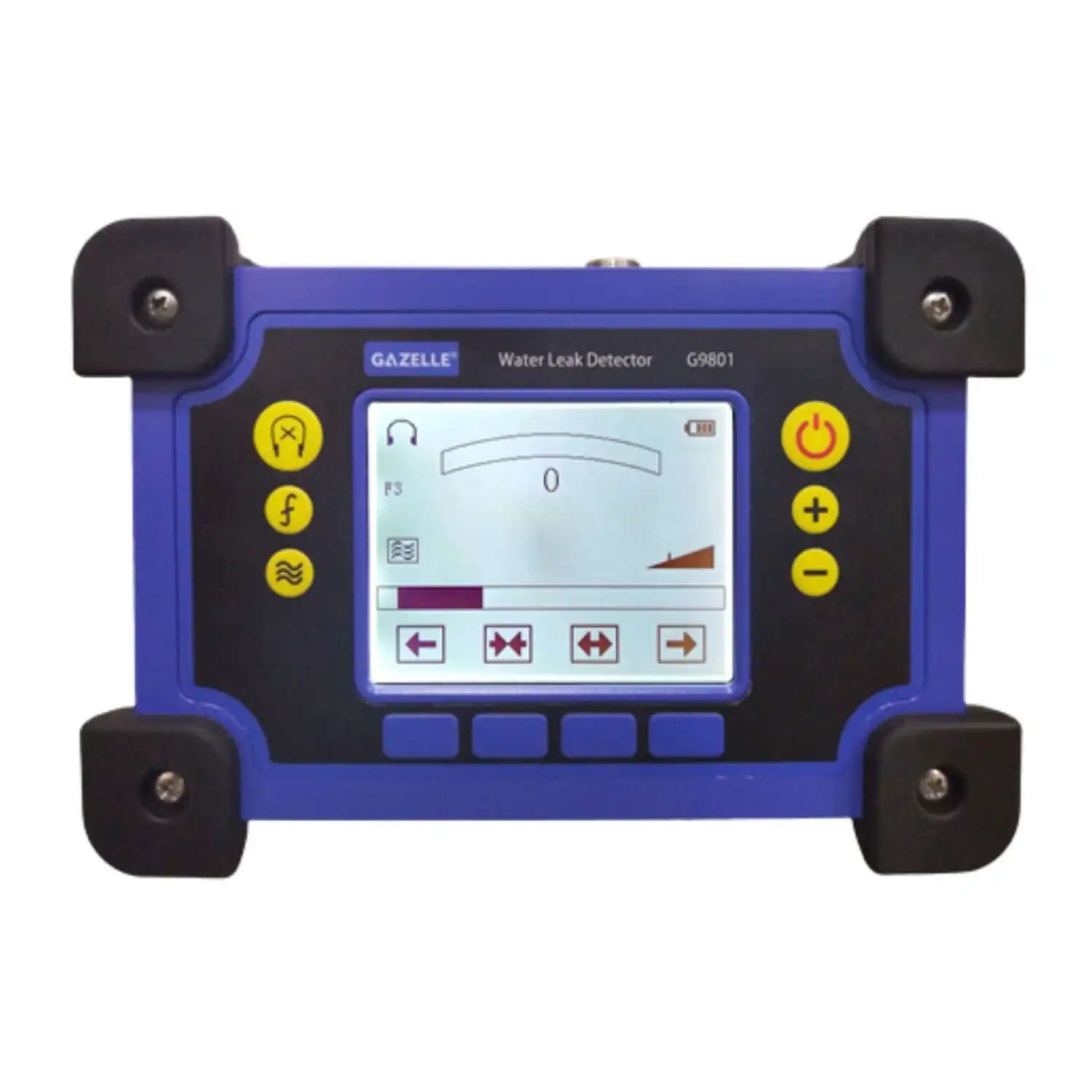
The Gazelle G9801 is a specialized acoustic leak detection instrument built for water pipes, supply lines and pressure pipes — and it solves the three problems above in order.
Sensitivity: a high-precision ground sensor picks up structure-borne vibration through tiles, plaster and screed, across a frequency range of 50 to 5,000 Hz. That range matters because different pipe materials sing at different pitches — metal pipes transmit higher-frequency leak sounds, plastic pipes lower ones — and the G9801 hears the full spectrum.
Amplification: up to 140 dB of adjustable magnification. In practical terms, a whisper inside your wall becomes clearly audible in the engineer’s dedicated aviation-grade headphones, with less than 1% distortion — so what we hear is the leak itself, not artifacts of the equipment.
Filtering — the real differentiator: the G9801 runs a 144 MHz digital signal processor performing live spectrum analysis and digital filtering. The engineer can isolate the frequency band where the leak lives and strip out the bands where the building noise lives. An AC compressor humming two rooms away simply disappears from the headphones; the hiss remains.
A signal-strength display reading from 0 to 99 turns hearing into measurement — and measurement is what makes the next part work.
From Hiss to Pinpoint: How a Detection Session Works
Clients often expect leak detection to look dramatic. It’s actually methodical — closer to a medical examination than a treasure hunt — and it’s how we detect a leak without breaking a wall:
First, we establish the pipe route, using drawings where they exist and wall scanners where they don’t. Then the sensor walks the route: placed on the surface every short interval, reading taken, position logged. Away from the leak, the signal reads low. Approaching it, the number climbs. Directly above it, the reading peaks — and stepping past it, the number falls again.
That peak is the leak, typically located within centimetres. The G9801’s leakage distribution recording mode logs the readings along the route, so the report doesn’t just say “there is a leak” — it shows the acoustic evidence trail that ends at an exact point on your wall or floor.
The repair contractor then opens one small, confirmed spot. Compare that to the traditional method — exploratory demolition, wall by wall — and you understand why non-destructive leak detection pays for itself before the first tile is ever lifted.
Three Jobs It Does Better Than Anything Else
The leaking pipe in a wall. The classic case: damp patch or bubbling paint, source unknown. Thermal imaging shows us where moisture is; the G9801 tells us where water is escaping — often a surprising distance from where the stain appears, because water travels along pipes and slabs before surfacing.
Water leaking from a ceiling. When the source is the unit above, access is politics as much as plumbing. Acoustic detection through the ceiling and the upstairs floor localizes the source line precisely — so the conversation with the neighbour or building management starts with evidence, not accusation.
The high water bill with no visible leak. A pressurized pinhole can waste hundreds of litres a week, 24/7, entirely out of sight — and DEWA notices before you do. Walking the supply routes with the sensor finds the silent spender in a single session.
The Honest Limits — and Why We Cross-Check
We tell clients what instruments can’t do, because that’s what separates an inspection company from a sales pitch.
Acoustic detection needs pressure — it hears water escaping, so it excels on supply lines but not on unpressurized drainage (that’s what our drain cameras are for). Very deep leaks, heavily insulated pipes, or extremely slow weeps can whisper below even 140 dB of gain. And a skilled ear is part of the instrument: distinguishing a leak’s signature from a partially open valve takes training, which is why every operator on our team is an InterNACHI-certified engineer.
Most importantly: no single reading writes our reports. Every acoustic finding is cross-confirmed with thermal imaging and moisture measurement at the flagged location before it’s documented. Three instruments agreeing is a conclusion; one instrument alone is a hypothesis. That discipline is why our leak reports hold up when developers, contractors, or upstairs neighbours push back.
Stop Guessing. Start Listening.
Water seepage never fixes itself — it compounds, quietly, until gypsum swells, tiles lift, and mold moves in. The difference between a small sealed joint and a renovated bathroom is usually nothing more than when the leak was found.
The G9801 is one of 40+ professional instruments on our Inspection Tools & Technology page, and acoustic detection is at the core of our water leak detection service — carried out across all 7 Emirates by certified engineers, with your photo-documented report delivered within 6 hours.
Hearing something? Seeing stains? Paying for water you never used? Book your leak detection today — we’ll find it without breaking a thing.