Snagging · Electrical
A socket can look perfect, sit dead level, and still be wired wrong.
Paint marks and chipped tiles announce themselves. Electrical defects do not. They sit behind sockets, inside the distribution board, above the false ceiling, behind the appliances and inside the joinery — and after handover, most of them are behind something you would have to take apart to reach.
- Applies to
- Handover, renovation and pre-purchase
- Best timing
- Before ceilings close and joinery fixes
- Covers
- DB, sockets, lighting, AC, appliances, access
- Our role
- We inspect — we never repair
- HiddenWhere the real defects live
- LabelsOften wrong at handover
- AccessThe defect nobody records
- Test itDon’t just switch it on
Electrical snagging inspection Dubai
Switching the lights on is not an electrical inspection
At a viewing, the lights work, the sockets look straight and the AC comes on. None of that tells you the installation was completed correctly. A proper electrical snagging inspection treats the wiring as a system: how the load is distributed, whether circuits are identified, whether protection is in place, and whether anyone will be able to reach the equipment when it needs attention.
It does not replace specialist electrical testing where that is required. What it does is find the things that should be investigated or rectified while the developer or contractor is still responsible for them. Those things are usually hiding here:
- Behind socket and switch plates
- Inside the distribution board
- Above the false ceiling
- Behind access panels
- Inside kitchen and wardrobe cabinets
- Around fan coil units and isolators
- Inside service risers
- Behind built-in appliances
Distribution board inspection
Start at the distribution board
The DB is where every circuit in the property is distributed and protected, which makes it the most informative five minutes of the inspection. Detailed verification belongs to a qualified electrician, but plenty is visible and functional.
Labels that don’t match the circuits
Missing labels, generic labels, or labels that simply describe the wrong circuit. Each breaker is switched and the affected outlets checked, because at handover the printed schedule is frequently wrong.
Why it matters: when something has to be isolated in a hurry, nobody should be guessing which breaker does it.
Signs of overheating inside the board
Discolouration, a faint burning smell, melted or distorted plastic, a breaker that feels warm. Thermal imaging over the board while it is under load shows hot spots at terminations.
Why it matters: heat at a connection means a loose or overloaded termination. It is referred to a qualified electrician immediately.
Residual current protection
Whether the arrangement is present and identified, the test button where provided, and any obvious damage. Detailed performance testing needs an RCD tester and a competent person.
Poor circuit separation and distribution
High-load equipment sharing circuits, no dedicated supply where the appliance needs one, or obviously uneven distribution across phases in a multi-phase property.
Why it matters: it shows up later as nuisance tripping, which owners usually blame on the appliance.
A board you cannot get to
Boxed in behind joinery, blocked by a decorative panel, a door that fouls the wall, or storage stacked in front of it. Common after a renovation, when interior design outranked the electrics.
Open ways, loose covers, damaged breakers
Unused ways left open, covers not seated, damaged or poorly mounted devices, and finishing that makes the labels unreadable.
A breaker that keeps tripping is telling you something
It is doing its job. Repeated tripping points to an overloaded circuit, a fault, an appliance problem or a wiring defect — and resetting it each time is not a fix. Record when it trips and what is running at the time, and have it investigated by a qualified electrician rather than lived with.
Socket testing Dubai
Sockets: what looking tells you, and what it doesn’t
Every accessible outlet is operated and tested, not just looked at. A socket tester indicates certain common wiring conditions at the outlet; it is one instrument in a wider assessment, not a full electrical test.
| Finding | What it usually means | Grade |
|---|---|---|
| Tester indicates missing earth | No fault path at that outlet — for immediate electrician referral | Critical |
| Tester indicates reversed polarity | Live and neutral transposed at the outlet | Critical |
| Socket dead | Not connected, not energised, or a faulty accessory | Critical |
| Accessory warm in use | Loose connection or overloading behind the plate | Critical |
| Plate moves when a plug goes in | Poor fixing to the back box | Major |
| Scorch marks or discolouration | Heating at the connection or a damaged accessory | Critical |
| Cracked plate or damaged shutters | Damaged accessory, replace before handover | Major |
| Not level, not flush, paint-covered | Finishing defect — still on the list | Minor |
| The limit | A socket tester indicates conditions at the outlet; it cannot verify the installation. Anything it flags goes to a qualified electrician. | |
Lighting circuits
Lighting: every point, every switch, every combination
A lighting circuit can work perfectly and still be wrong. Configuration is part of the inspection, not just function.
Function
- Every light point and every switch operated
- Flickering, delay or buzzing on any circuit
- Dimmers across their full range
- Feature, wardrobe, mirror and under-cabinet lighting
- External and balcony lighting
- Fittings secure, aligned and cleanly cut into the ceiling
Configuration
- Is the entrance light switched at the entrance?
- Do two-way switches work from both positions?
- Does each switch control the light you expect?
- Are switch banks in a sensible order?
- Do drivers and transformers remain replaceable?
- Do smart controls address the right room?
Flickering is often just a lamp. If it continues after the lamp is changed, it points at a loose connection, a driver, the switch or the supply, and needs investigating rather than tolerating.
Hidden electrical defects
Above the false ceiling: the part nobody sees again
Ceiling voids hold cabling, junction boxes, AC wiring, drivers, transformers, data cables and lighting connections. Workmanship up there is invisible from the moment the last board goes up, so it is inspected through access panels and light cut-outs while that is still possible.
Boxes left open
Missing covers, exposed terminals, conductors outside the enclosure, poor cable entry. Connections should never be left open above a ceiling.
Cables lying on sharp metal framing
Ceiling systems are full of cut metal edges. Cable resting on them, or pulled across them, has its insulation worn away over time by vibration and movement.
Why it matters: the damage happens years after handover, in a place nobody is looking.
Cable thrown in rather than routed
Loose hanging loops, unsupported bundles, cables resting on ductwork or draped over hot equipment, services of different types mixed with no organisation.
Panels that reach nothing
Too small, in the wrong bay, or a comfortable distance from the junction box, driver or AC isolator they are supposed to serve. Technically an access panel; practically no access.
Why it matters: the alternative is cutting the ceiling, which the owner pays for.
Isolators sealed above the ceiling
An AC isolator behind a fixed board or a decorative panel leaves the technician with no safe way to isolate the unit for service.
Nothing labelled
Unidentified cable in a void is a maintenance problem for the life of the property. Neat, identified work stays neat even where it is hidden.
Appliance power & access
Kitchens: where electrical planning meets joinery
Most kitchen electrical defects come from sequence: the cabinets were designed first and the electrics fitted around them. The result works on day one and becomes unserviceable on day two.
Supply
- Oven and hob supplies suitable for the appliance installed
- Dishwasher, washing machine and dryer provision
- Cooker hood, microwave and fridge points
- Worktop sockets for small appliances
- Dedicated circuits where the appliance requires one
- Outlets sensibly placed relative to the sink and hob
Access & isolation
- Isolation reachable without dismantling joinery
- Plugs not crushed between appliance and wall
- Sockets not sealed directly behind a fixed appliance
- Cable clear of ovens, hobs and other heat sources
- No extension leads doing a permanent job
- Junction boxes inside cabinets still accessible
Permanent extension leads and multi-plug adaptors behind appliances are a finding, not a workaround. They usually mean the installation did not provide enough points where they were needed.
Wet areas, AC & outdoors
Where electricity meets water and weather
- Bathroom light fittings suitable and cleanly installed
- Extract fan operating, and its opening properly cut and sealed
- Water heater isolation, wiring and control area condition
- Any signs of heat or moisture at heater connections
- Switches and accessories appropriate for their position
- Outlets not carelessly placed near basins, sinks or wet zones
- Balcony and external fittings, covers and weather exposure
- Landscape and pool-area electrical points where present
- AC isolators reachable and undamaged
- Thermostats: display, adjustment, mode and response
- Fan coil unit electrical connections where accessible
- Condensing unit supply and isolation where applicable
Renovation-introduced defects
What changes when a contractor reworks the electrics
Renovation is when most of these defects are created. Sockets move, lighting is added, new appliances arrive, old cables get extended and wiring disappears inside new joinery — often with no drawing to show where any of it went.
- Circuits added with no update to the DB labelling
- Existing cables extended inside concealed joints
- Junction boxes buried permanently in fixed joinery
- Sockets relocated behind newly fitted appliances
- DB boxed in by new cabinetry or panelling
- Isolators covered by decorative finishes
- Access panels omitted from the new ceiling
- High-load appliances added to existing circuits
- Cable routed close to new heat sources
- Drivers and transformers sealed above plaster
- Loads added with no check of available capacity
- No record kept of what was changed or where
Photograph every cable route, junction and isolator before the ceiling closes and the cabinets go in. Those photographs are worth more than any certificate when something has to be traced in year three. Stage inspection
Instruments and their limits
What each tool can and cannot tell you
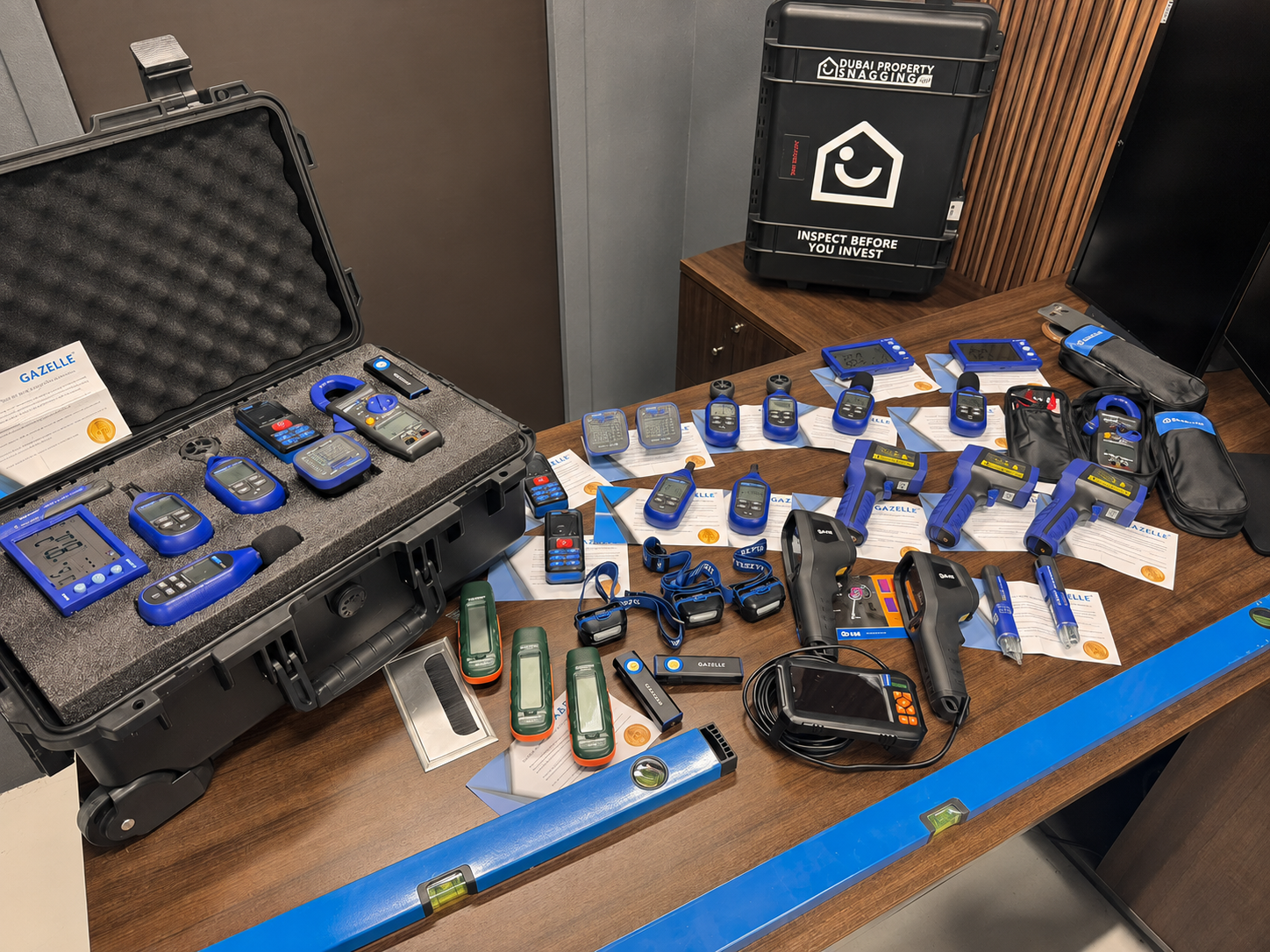
No single instrument verifies an electrical installation. Each answers one narrow question, and all of them are used within the agreed scope and by someone competent to use them safely.
| Instrument | What it shows | What it does not do |
|---|---|---|
| Socket tester | Common wiring conditions at an accessible outlet | Verify the installation or the earthing system |
| Non-contact voltage detector | Whether a point is live, and metal parts that should not be | Measure anything, or prove a circuit is safe |
| Multimeter | Voltage, continuity and resistance readings | Replace formal testing and certification |
| Clamp meter | Running current without disconnecting the circuit | Assess protective device suitability on its own |
| RCD tester | Whether residual current protection operates as expected | Cover circuits it is not connected to |
| Thermal camera | Hot spots at boards, breakers and terminations | Prove the cause — it shows temperature, not faults |
| Our position | Snagging is visual and functional within scope. Anything flagged goes to a qualified electrician for proper testing. | |
More on the instruments we carry: our inspection tools.
Stop and call a qualified electrician if you notice any of these
A burning smell, warm or discoloured sockets, melted accessories, buzzing from a switch or the board, visible sparks, exposed conductors, damaged cable insulation, or a breaker that trips repeatedly. These are not snag-list items to raise next month.
Electrical snagging checklist
Room by room, before you accept
Distribution board & protection
- Accessible, door operating, breakers reachable
- Every circuit labelled and labels verified
- No damage, no open ways, covers seated
- No discolouration, smell or warmth
- Residual current protection present and identified
- No earthing concerns flagged at outlets
Sockets, switches & lighting
- Every outlet tested and functional
- Accessories secure, level and undamaged
- Every light point and switch operated
- No flickering, delay or buzzing
- Switch logic sensible and two-ways working
- Data, TV, intercom and doorbell points checked
Kitchen, bathrooms & AC
- Oven, hob, dishwasher and washer supplies checked
- Appliance isolation reachable, plugs not crushed
- Bathroom fittings suitable, extract working
- Water heater controls and connections checked
- AC isolators accessible, thermostats responding
- Outdoor fittings, covers and exposure checked
Concealed work & access
- Junction boxes closed wherever accessible
- Cables supported, clear of sharp edges and heat
- Access panels positioned to reach real services
- Drivers and transformers replaceable
- No permanent extension leads or adaptors
- Smart controls addressing the correct rooms
Priorities
Cosmetic and technical are not the same list
Cosmetic — fix before you move in
- Socket or switch plate slightly off level
- Paint over an accessory or its screws
- Poor finishing around a back box
- Untidy cut-out around a downlight
Technical — fix before you accept
- Exposed conductors or an open junction box
- Any indication of missing earth or reversed polarity
- Heat, discolouration or a burning smell
- Repeated tripping or a suspect protective device
- Isolation or a DB that cannot be reached
- Cable damaged, unsupported or against sharp metal
Before the final payment
The sequence that gets electrical defects fixed
- 1
Inspect before concealment
Ceiling voids, cable routes, junctions and isolator positions checked while they are still visible, and photographed.
- 2
Contractor completes the works
Including testing, commissioning and any certification required for the work carried out.
- 3
Electrical snagging inspection
A numbered, photographed list, with technical findings separated from cosmetic ones.
- 4
Rectification
Items corrected by the contractor, with anything safety-related handled by a qualified electrician.
- 5
De-snagging
A return visit to confirm what was actually fixed, rather than what was reported as fixed.
- 6
Final payment released
On the contract terms, with any retention handled as agreed. Payment verification
If an electrical defect is hidden now, it is far harder to reach after handover — and it is yours.
Questions owners ask
FAQs: electrical snagging in Dubai
Scope and safety
What does an electrical snagging inspection cover?
The distribution board, circuit identification, accessible sockets and switches, lighting and switch configuration, appliance supplies and isolation, AC electrical points, bathroom and external fittings, concealed wiring visible through access panels, and maintenance access throughout. It is a visual and functional inspection within the agreed scope.
Is snagging the same as an electrical test and certificate?
No. Formal testing and certification is carried out by a qualified electrician using specialist instruments. Snagging identifies defects and conditions that should be investigated or rectified, and refers anything safety-related for that testing.
Do you carry out live electrical testing?
Checks are made only where safe and within the agreed scope, using appropriate instruments. Anything requiring specialist testing or work inside the installation is referred to a qualified electrician.
Can you inspect before the power is connected?
Partly. Visual condition, cable routing, junctions, access and installation quality can all be assessed. Anything needing live power, such as socket testing, lighting operation and current measurement, has to wait until the supply is on.
Do you carry out the repairs you find?
No. We inspect — we never repair, and we quote for none of the remedial work. That is what keeps the report independent.
Common findings
The socket tester flagged a problem. How serious is that?
An indication of missing earth or reversed polarity is treated as critical and referred to a qualified electrician straight away. The tester shows a condition at that outlet; establishing the cause and the extent requires proper testing.
Why does my breaker keep tripping?
Because it is protecting something. Common causes are an overloaded circuit, a faulty appliance, a wiring defect or a fault on the protected circuit. Note when it trips and what is running, and have it investigated rather than repeatedly reset.
My lights flicker. Is that a defect?
It can be as simple as a lamp. If it persists after the lamp is changed, it points at a loose connection, a driver, the switch or the supply, and should be looked at properly.
Is a warm socket normal?
No. Warmth, discolouration or a burning smell at an accessory suggests a loose connection or overloading. Stop using it and have it checked by a qualified electrician.
Are DB labels usually correct at handover?
Often they are not. Each breaker is switched and the affected outlets checked, which regularly shows labels that describe the wrong circuit or say nothing useful at all.
Access, appliances and renovation
Why is maintenance access treated as a defect?
Because an installation that cannot be reached cannot be maintained. An AC isolator sealed above a ceiling, a DB boxed in by joinery, or a junction buried inside a fixed cabinet turns every future repair into a joinery job.
Is a socket behind a built-in appliance a problem?
It depends on whether it can still be reached and whether the plug is crushed. A point sealed permanently behind a fixed appliance, with no accessible isolation, is recorded as a finding.
Are extension leads acceptable in a new or renovated home?
As a permanent arrangement, no. Extension leads and multi-plug adaptors hidden behind appliances usually indicate the installation did not provide enough points where they were needed.
What should I check after a renovation specifically?
Any circuit added, socket moved, load increased or cable extended, plus DB labelling updated to match, junctions left accessible, access panels provided in the new ceiling, and isolators not covered by new finishes.
When is the best time to inspect the electrics?
Before the ceiling closes and before joinery is fixed, then again at final snagging with everything operating. The first visit is the only chance to see cable routes, junctions and supports.
Can thermal imaging find electrical problems?
It highlights hot spots at boards, breakers and terminations that warrant investigation. It shows temperature rather than the fault itself, so findings are passed to a qualified electrician. Thermal imaging inspection
How we can help
Electrical snagging inspection in Dubai
What the inspection includes
- Distribution board condition and circuit identification
- Socket and switch testing at accessible points
- Lighting operation and switch configuration
- Appliance supplies, isolation and access
- AC electrical points and thermostat response
- Concealed wiring through access panels
- Thermal check of the board under load
Related reading & services
Important note
Electrical snagging provides visual and functional observations based on the accessible condition of the property within the agreed scope. It is not an electrical installation test, inspection certificate, design review or statutory approval. Testing, certification and any work inside the installation must be carried out by a suitably qualified electrician in accordance with applicable requirements and the approved design.
Find the electrical defects while they are still reachable
Board, circuits, sockets, lighting, appliance supplies and concealed wiring — tested and documented in a numbered photographic report before you sign. We inspect — we never repair.
DED Certified · RERA Approved · InterNACHI Certified · 98,000+ Inspections