A property snagging checklist is a room-by-room list of everything to test and inspect before you accept a new home from the developer. If you are in Dubai, finding and fixing problems is still your responsibility. Whether you are doing the checks yourself or using a professional service, here is the list of things to check:
Developers are handing over thousands of new homes across Dubai in 2027, from JVC and Business Bay to Dubai Hills. A cracked tile or a weak socket is annoying. A failed shower waterproofing or a blocked AC drain can cost thousands of dirhams if you only find it after the warranty ends.
That’s why property snagging in Dubai has become a normal step before collecting the keys. This guide describes what “good” looks like, shows you when it makes sense to bring in a handover snagging team, and takes you through each room in the sequence an inspector would.
Before You Start: Timing and Tools
When to snag. The best time is when the developer invites you for the pre-handover or handover inspection, and before you sign the handover papers. If you have already moved in, you can still snag during the defects liability period, which is usually 12 months for installations such as plumbing and electrics. Just do it early.
Ask for power and water. You can’t test sockets, AC or drainage in a unit with no utilities. Ensure DEWA is connected before your inspection day by asking the developer.
Basic tools for a DIY check:
- A phone camera, and a notebook or snag-list app
- A socket tester and a phone charger for checking sockets
- A spirit level and a small torch
- Masking tape or sticky notes to mark defects
- A bucket of water for drain tests
- A coin or a key for tapping tiles to hear hollow spots
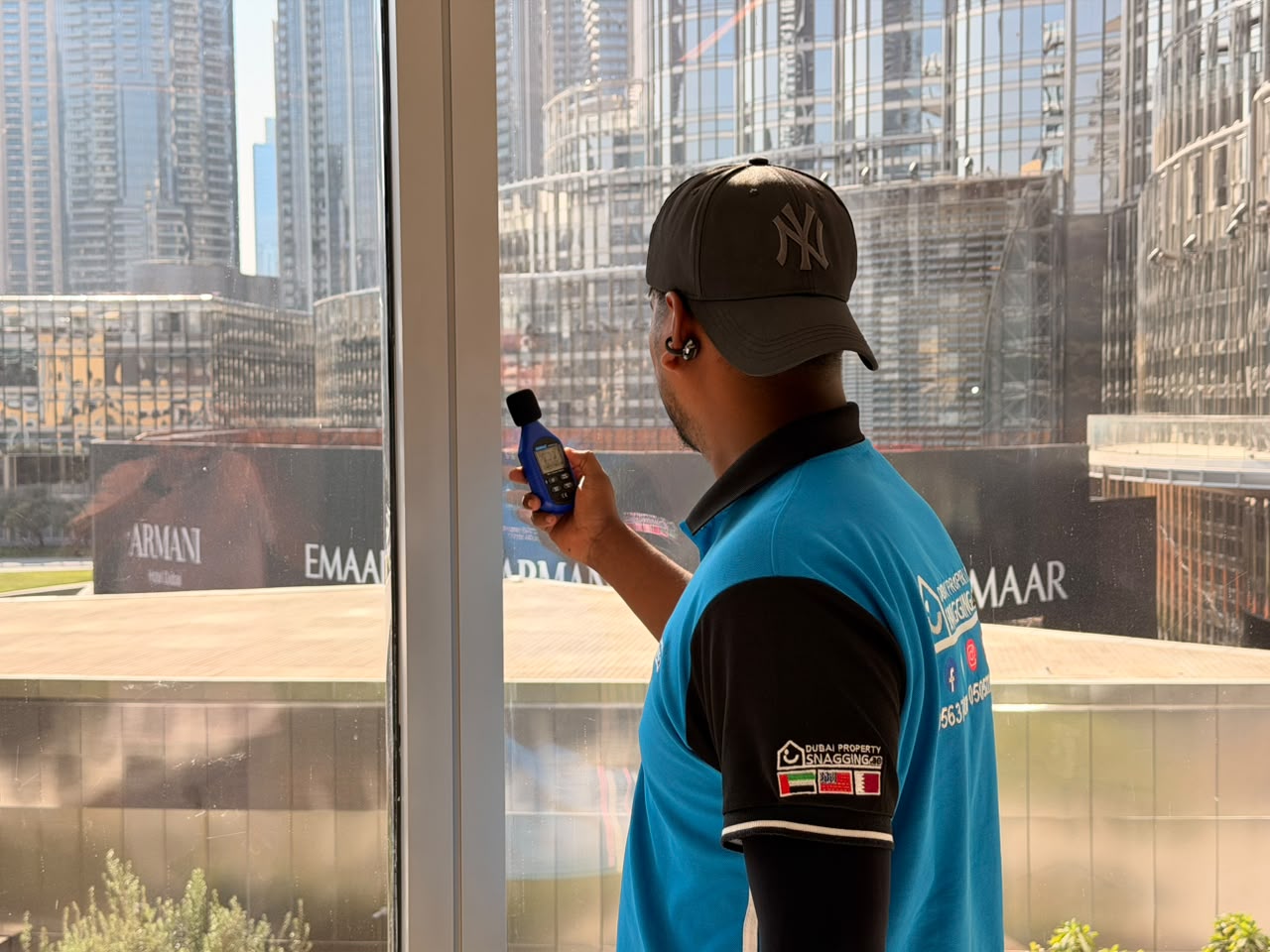
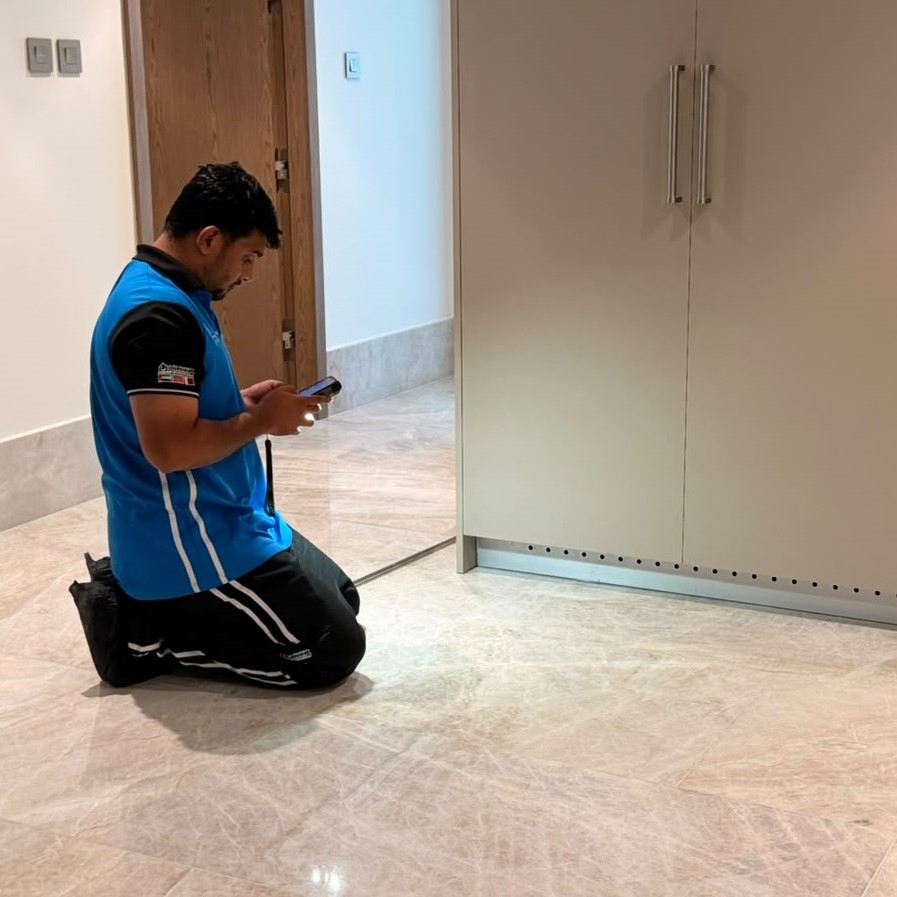
Professional teams go further, with thermal cameras, moisture meters and laser levels. You can see the kind of inspection equipment a full inspection uses. Allow 2 to 3 hours for a one-bedroom apartment and most of a day for a large villa.
1. Entrance, Living and Dining Areas
Start at the front door and work clockwise around each room. This ensures you do not skip anything.
- Main door opens, closes and locks smoothly, with no gaps around the frame
- The installer fits the door viewer, handle, hinges, and door stopper tightly.
- Floor tiles are level, with even grout lines and no chips or cracks
- Tap tiles with a coin and listen for a hollow sound, which means poor adhesion
- We fix skirting with no gaps, and we ensure silicone joints are neat.
- Walls and ceilings have even paint, no patches, cracks or drips
- Ceiling access panels open and close, and the false ceiling has no sagging
- Every light switch works and every socket has power
- We fit TV, data, and phone points.
- We fitted the smoke detectors and sprinkler heads, and they are undamaged.
Tip: Look along walls with a torch held flat to the surface. Side lighting shows up uneven plaster and patchy paint that you’d miss in normal light.
2. Kitchen
The kitchen has water, power, heat and moving parts all in one small space, so it usually has the most snags of any room.
- The cabinet doors align, close softly, and do not rub against each other.
- Drawers slide fully open and closed, and the handles are tight
- The installer ensures the worktop is level, free of chips, and seals the joints.
- Silicone is unbroken where the worktop meets the wall and the sink
- Hot and cold water both run, with good pressure
- Fill the sink, let it drain, and check underneath for drips
- The base board under the sink is dry and not swollen
- The hob, oven, hood and any built-in appliances switch on and work
- The cooker hood extracts air, with the duct connected to the outside
- We place the sockets correctly for each appliance.
- The installer fits and caps the washing machine and dishwasher connection points.
Watch for: Swelling at the bottom edge of the sink cabinet. It’s an early sign of a slow leak from the waste pipe or the tap connection.
3. Bedrooms and Wardrobes
Bedrooms look simple, but people often rush them. Take your time here.
- Doors swing freely, latch properly and don’t drag on the floor
- Wardrobe doors are aligned, with working hinges, rails, shelves and soft-close fittings
- The inside of the wardrobe is finished, with no raw edges or missing panels
- Flooring is level with no gaps, and if it’s wooden, check that it doesn’t creak or lift
- Every socket, switch and light point works
- However, the AC outlet blows cold air within a few minutes, and the thermostat responds.
- Windows open, close and lock, and blinds or curtain tracks are fitted if they’re included
- Moreover, walls and ceiling are free of cracks, damp patches and paint defects.
Moreover, stand quietly in each bedroom with the AC running. A rattling grille or a humming fan coil is far easier to get fixed now than after you’ve moved your furniture in.
Next, Additionally, Bathrooms and Wet Areas. Bathrooms and Wet Areas
If you only have time to check one room properly, make it the bathroom. Additionally, water damage from a poorly built shower is costly in Dubai homes and often stays hidden for months.
- Run the shower for several minutes and check that water flows to the drain without pooling
- The floor slopes toward the drain, so water doesn’t sit in corners
- Silicone around the shower tray, bath, basin and WC is unbroken
- Grout is complete, with no cracks or gaps
- Flush the WC several times, then check it refills properly and doesn’t keep running
- Look behind and under the WC and basin for drips
- Hot water reaches every tap within a reasonable time
- The exhaust fan works and pulls air (hold a tissue up to it)
- Mirrors, towel rails, the shower screen and accessories are fixed firmly
- Glass shower screens have safety marking and close without leaking
- Ceilings and walls in the next rooms show no stains or bubbling paint
A leak inside a wall won’t show up on the day of handover. That’s where thermal imaging earns its place: it displays cooler, wet areas behind the tiles. If you already see stains, a dedicated water leak detection test can trace the source without breaking the tiles.
5. Balcony, Terrace and Windows
Dubai’s winter storms are short but heavy. If a balcony slopes the wrong way or a window seal is weak, the water ends up inside your living room.
- Pour a bucket of water on the balcony floor and check that it runs to the drain, with no pounding
- The balcony drain is clear and has a cover fitted
- Railings and glass panels are firm, at a safe height, with no sharp edges
- The sliding door runs smoothly, locks and seals fully when closed
- The door threshold is sealed and slightly higher than the balcony floor
- Window frames have unbroken sealant inside and out
- The glass is free of scratches, chips and cracks
- Window handles and child safety restrictions work
- External lights and sockets, if fitted, work and are weatherproof
For roof terraces and large balconies, ask whether the developer has done a flood test on the waterproofing. If they have, request the results. If not, it’s worth asking for one before handover.
6. MEP: Electrical, Plumbing and Air Conditioning
MEP stands for mechanical, electrical and plumbing. These are the systems you can’t easily see but use every day, so they need to be tested, not just looked at.
Electrical
- The distribution board (DB) is labeled, with every breaker named
- The main switch and each RCD/ELCB trip when you press the test button
- Every socket has power, correct polarity and a working earth (use a socket tester)
- Light fittings are all working, with no flickering
- The doorbell and intercom work, along with any smart-home panels
Plumbing
- The water heater heats up and has a working safety valve
- The main isolation valve is easy to reach and shuts off the water
- Water pressure is steady at every tap
- No gurgling or bad smells come from the drains
Air conditioning
- Every room reaches its set temperature within a reasonable time
- The thermostats respond and each zone can be controlled separately
- The condensate drain flows freely, with no water stains near the AC units
- AC filters are clean and the access panels open easily
MEP faults are among the hardest things for a beginner to judge. A professional apartment snagging inspection checks these systems with proper meters and records the readings in the report.
7. Villas and Townhouses: Extra Checks
If you’re receiving a villa or townhouse, add these to your list on top of the room-by-room checks above.
- The roof is free of standing water, with clear drains and intact waterproofing
- External walls have no cracks, and expansion joints are sealed
- Garden levels slope away from the house, so rain doesn’t run toward the walls
- The irrigation system covers the garden evenly, with no leaking joints
- The garage door opens and closes safely and its motor works
- Staircase handrails are firm and the treads are level
- The maid’s room, laundry and outdoor kitchen have the same checks as the main rooms
- Outdoor sockets and lights are weatherproof
- The pool (if there is one) holds its water level, and the pumps, filters and lights work
Villas have far more surface area, more systems and more places for water to get in. That’s why a dedicated villa snagging inspection takes longer than an apartment. If your villa has a pool, a separate pool and spa inspection checks for leaks and equipment faults.
DIY Snagging or a Snagging Company in Dubai?
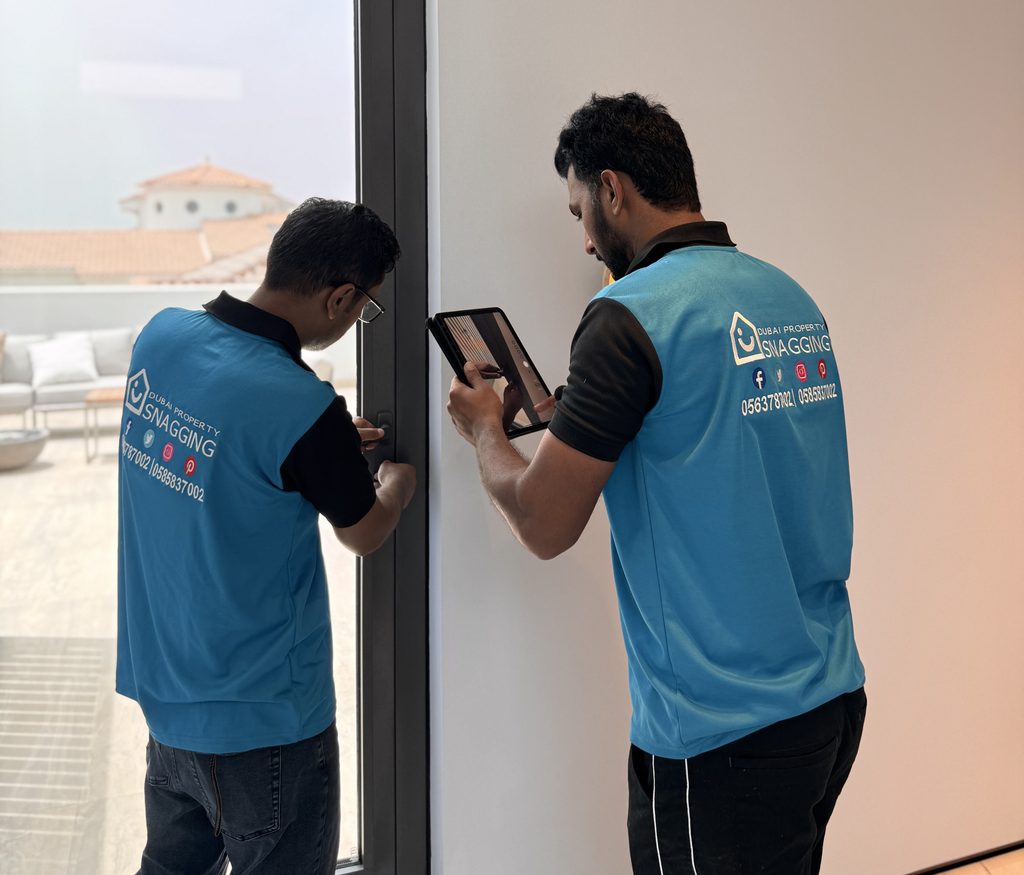
You can find many obvious flaws on your own with the use of this checklist. However, some of the most expensive issues are those that are impossible to notice or diagnose without the proper equipment and expertise.
| DIY with this checklist | Professional snagging company | |
| Visible finishes (paint, tiles, doors) | Good | Thorough, with every snag photographed and located |
| Hollow tiles and uneven levels | Partly, with a coin and a spirit level | Systematic tapping and laser levels |
| Hidden leaks and missing insulation | Not possible | Thermal camera and moisture meter |
| Electrical safety (earthing, RCD) | Basic socket test | Full test with meters |
| AC performance | “Feels cold” | Measured temperatures at each outlet |
| Report the developer accepts | Your own notes and photos | Formal report with photos, locations and references |
| Re-inspection after repairs | You go back yourself | De-snagging visit offered |
If you do hire a snagging company in Dubai, check that it holds a valid trade license and recognized certifications such as RERA approval and InterNACHI training. Ask to see a sample snag report before you book, and find out what it costs for your property size. If you’re comparing options, here’s why buyers and agents choose our team.
After the Inspection: Report, Fix, Re-Check
Finding the snags is only half the job. Here’s how to make sure they actually get fixed.
- Put everything in one report. Each snag should have a photo, the room, its exact location and a short description. Number the items so you and the developer can refer to them easily.
- Send it to the developer in writing. Email it to the customer care or handover team and ask for a reference number and a target completion date.
- Don’t sign off on unresolved major items. Minor cosmetic snags can be fixed after you move in. Leaks, safety issues and non-working systems should be resolved first, or at least formally recorded in writing.
- Book a de-snagging visit. When the developer says the repairs are finished, go back through the list item by item. Our guide on snagging vs de-snagging explains what this second visit covers.
- Diaries your warranty end date. Book a DLP inspection a month or two before your defects liability period ends, so anything that has appeared since handover is still the developer’s responsibility.
Frequently Asked Questions
What is a property snagging checklist?
It’s a room-by-room list of items to test and inspect in a new property before handover, such as doors, tiles, sockets, plumbing, AC and waterproofing. It helps you record defects so the developer can fix them.
When should I do property snagging in Dubai?
Ideally during the developer’s pre-handover or handover inspection, before you sign the handover papers. If you’ve already moved in, snag as early as possible within your defects liability period.
How many snags does a new apartment usually have?
It fluctuates depending on the builder and the specific development. by developer and building, but it’s normal for a brand-new apartment to have dozens of snags and a large villa to have many more. Most are minor finishing issues. You can see the kind of defects found in our real defect case studies.
Can I use this checklist instead of a snagging company in Dubai?
You can use it to catch visible defects yourself. Many purchasers utilize the checklist in conjunction with a professional assessment because hidden leaks, electrical safety, and AC performance require the right instruments.
Is the developer obliged to fix snags?
Yes. Developers are required by Dubai’s jointly owned property regulations to fix faulty installations for a predetermined amount of time following handover, typically a year. Your sale agreement contains the precise terms.
How long does a property snagging inspection take?
Around 2 to 3 hours for a one-bedroom apartment, and most of a day for a large villa.
Accept the Keys With Confidence
A new home in Dubai is a big investment, and the day you accept the keys is your best chance to get defects fixed at no cost to you. Work through this checklist room by room, photograph everything, and put it all in writing to the developer.
For issues you cannot assess yourself like hidden leaks, electrical safety, or air-conditioning performance a professional inspection provides a complete picture. Dubai Property Snagging certified inspectors cover apartments, townhouses and villas across Dubai and the other emirates. You get a detailed, photo-backed report the developer can act on straight away.
Ready for Property Snagging Dubai buyers can trust? Book an inspection or call or WhatsApp +971 56 378 7002.