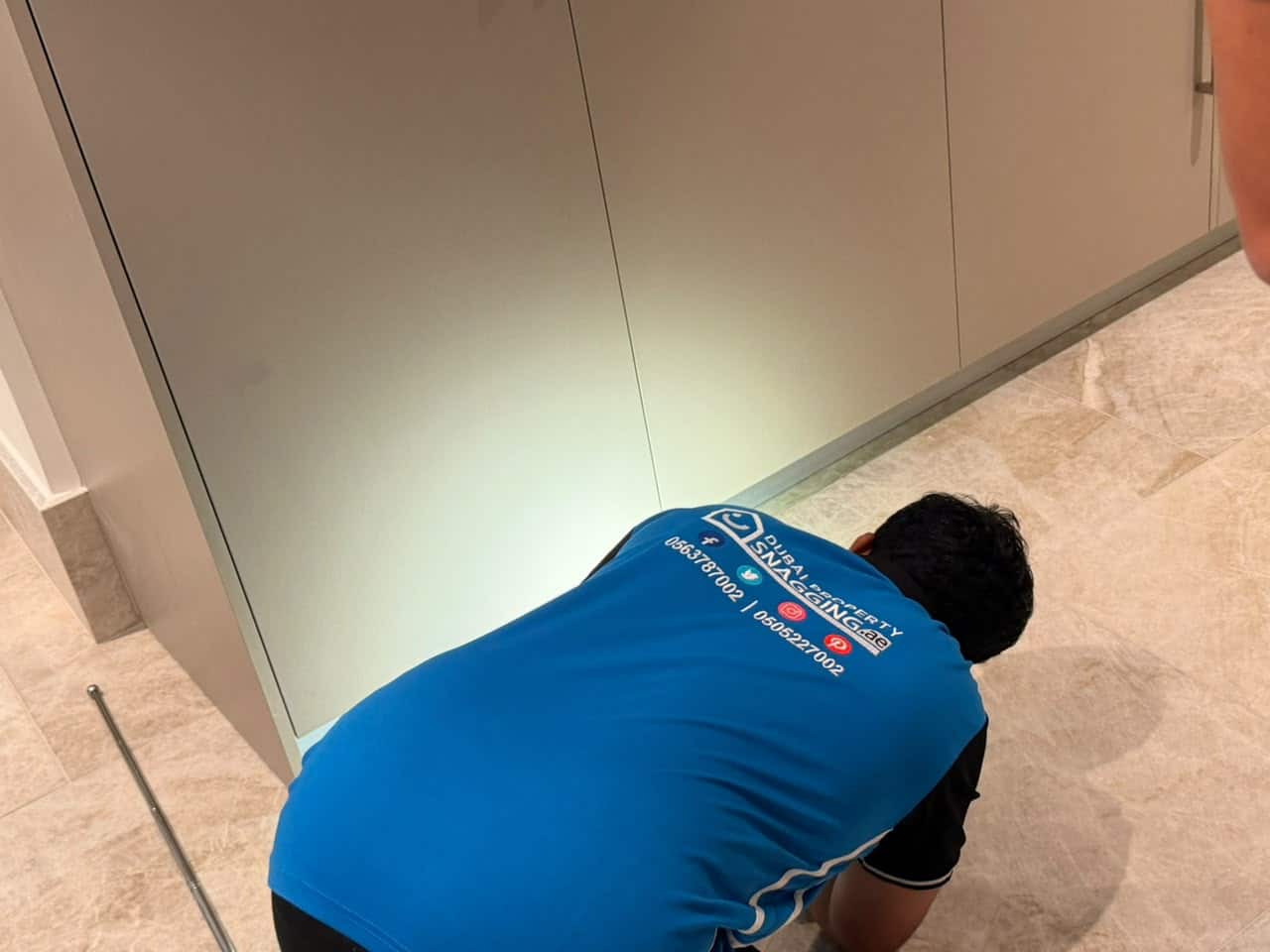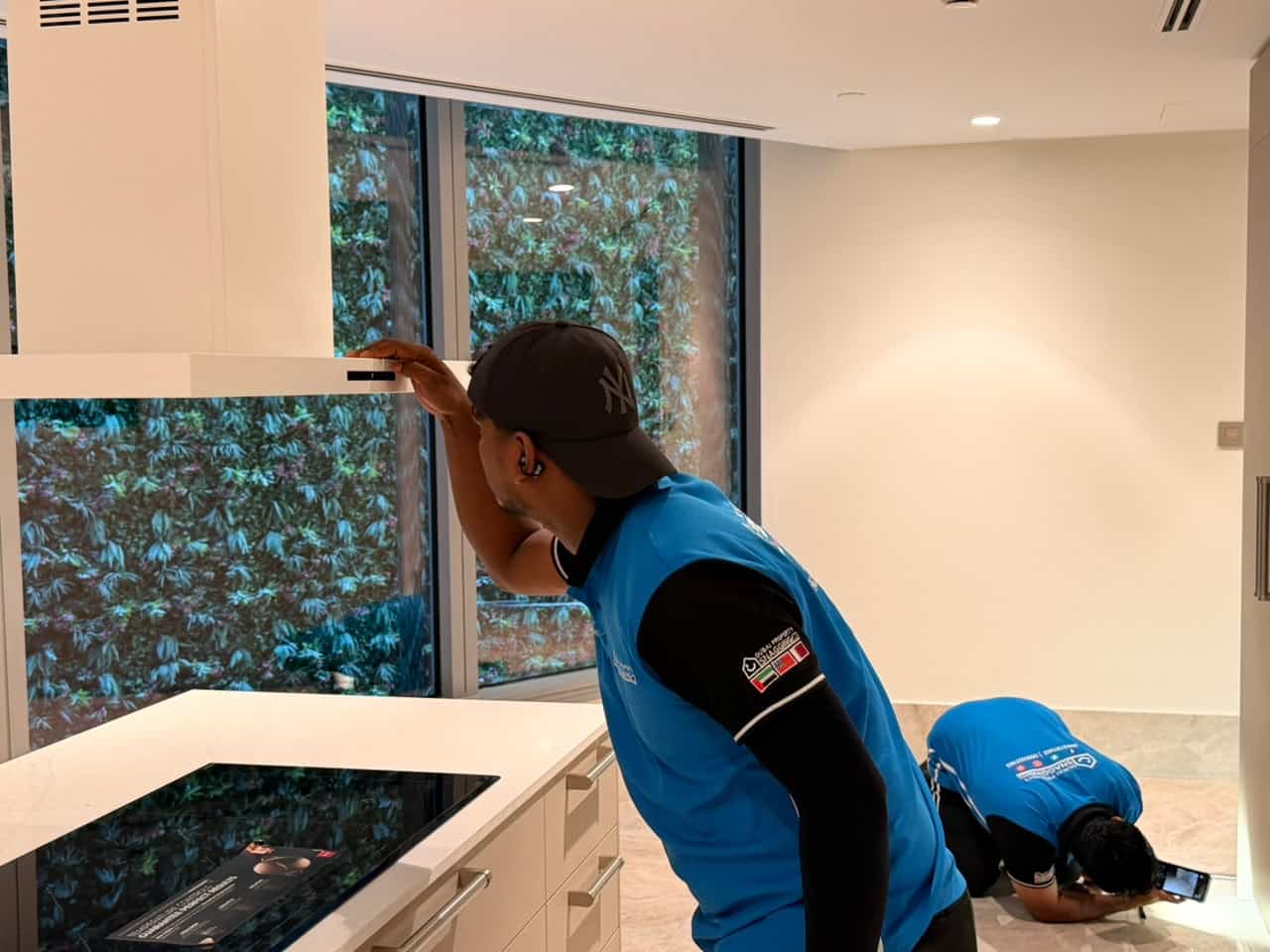
Produce a record of all snags, ideally using a professional inspection report, to help you Fix Snagging Defects effectively. Report the issues to your developer and obtain a ticket number for each defect. Agree on a repair time frame, then arrange a de-snagging inspection to verify that the developer has completed the repairs properly.
For apartments, as well as townhouses and villas in shared ownership – the developer is responsible for repairing faulty installations in Dubai for 1 year and structural problems for 10 years from handing over a unit.
Whilst identifying snags is often relatively simple, persuading a developer to repair effectively is usually where purchasers struggle.
All too commonly, people produce a comprehensive snag list. They then contact their developer – and in many cases, there is no further response. The developer may ask customers to resend snag images; meanwhile, a service engineer may visit and repair some reported snags. They will then often close the entire snag list.
Based on our experience of over 10 years and 98,000+ handover inspections in the UAE we understand the factors that cause developers to respond to snag lists and those that lead to a lack of response. Whilst neither luck nor a developer’s size has a great effect on their responsiveness, it is largely about how, when and to whom you report snags.
This step-by-step guide describes how to successfully report and resolve snags. It is suitable for first time purchasers, experienced investors and their agents.
Know What the Developer Is Responsible For
Understanding this helps you to negotiate with confidence. For shared-ownership developments, Dubai Law No. 6 of 2019 – ‘Shared Ownership’ is key. Under Article 40:
- Structural problems – the developer is responsible for repairing or correcting these for 10 years from a development receiving a completion certificate.
- Faulty installations – the developer is responsible for repairing or replacing these (for example, heating/air conditioning, electrical and water and drainage) for 1 year from handover of a unit.
- No contract can override these responsibilities. Even if hidden deep in your sale and purchase agreement (SPA), any such clause is invalid.
As well as the above developer responsibility period, your SPA may also state its own defects liability period (“DLP”) and reporting procedures. Please review this prior to handover so you understand how and when to report snags to your developer.
Although the legal wording is important, two further areas are key in practice:
Installation fault repair periods begin on the handover date. If you receive keys and then leave a unit empty for 6 months, half your 1 year period has already expired.
Good evidence is essential to ensure that your developer acknowledges and resolves a problem. Although the law ensures your rights, your developer will need good evidence of both the nature and date of a snag.
Our article on RERA requirements provides further guidance about the handover process. If your first year is drawing to a close then a DLP inspection will identify any new snags that have developed since you moved in.
Note that this is general information only. Please consult a qualified UAE property lawyer if you face a legal matter.
Step 1 – Create an Unmissable Snag List (Pre-Handover)
Prior to signing off on handover, you are in the strongest possible negotiating position. After sign-off, many developers treat the unit as accepted, making your requests secondary to its acceptance conditions.
Successful snag lists will generally:
Include photographs. Again, rather than a general image of a room, these should focus on the snag. Ideally, this will also be accompanied by a wider picture to illustrate where it is.
Clearly show where a snag is. For example, someone can fix “Master bathroom, shower wall, second tile from the left, 1.2 m high.” However, a generic description such as “Tiles in bathroom” often leads to arguments.
State succinctly what the problem is. For example, “Hollow tile, sounds loose when tapped” or “non-working socket”. Technicians can easily understand and act on these.
Evidence of underlying issues is provided. Although there may currently be no visual indication of a problem, for example, a shower wall may be damp but not obviously so. Thermal imaging can then highlight the chilly, damp area, making the evidence difficult to dispute.
Priorities safety concerns. For example, loose balcony balustrade, unsafe wiring and earth leakage should be at the top of your list, not tucked away at, for example, number 64.
This is typically why clients employ a professional inspector. Not only can they identify snags, but they can also present them in a format that is easy for a developer’s service engineers to understand. Good inspectors will also know the favored reporting format for different developers to avoid unnecessary correspondence.
Step 2 – Report Snags Correctly
Equally, as well as the content of your snag list, the method of reporting is important.
Report via your developer’s recognized reporting system. Most major developers have either a website portal, an email address for their handover department or an app for snag reporting. In addition to using these, it is also advisable to WhatsApp the handover officer. However, if this person moves to another role, they may lose your messages.
Always obtain a ticket or case number. Each report should result in one of these. If not, contact your developer and request one. This evidence verifies when you reported a snag. It can also help resolve queries about the 1 year period for installation fault repair.
Attach the full snag report (including photographs) to your report. Even if your developer’s portal only permits brief text, please attach your full report and refer to snag numbers. You can view an example snag report, and our article on analyzing one details its contents.
Request a formal repair schedule. Adding a polite line such as “Kindly advise us of the planned repair completion date for the above” transforms a response of “we’ll look into it” into a binding commitment.
Make copies. Print or save electronic versions of both communications and screen shots of online reports. Also retain the original date stamps on photographs. Create one folder for each property. You will be thankful for this if any issues arise.
Step 3 – Continue to Monitor Repair Implementation
Often, this is where people’s claims fail. A developer’s engineers attend, resolve some snags, and then close the snag report. Here is how to successfully monitor repair implementation in Dubai.
Ensure that you or someone else is present for the engineers’ visit. Ask them to examine each snag on your list. If they are unable to resolve a snag on the day, ask them to record that it still requires attention.
Do not sign off on a completion form until you verify that those responsible have addressed every snag. Engineers frequently provide a form to confirm that they have completed all repairs. By signing this before all items have been resolved, you are reducing the strength of your claim. If you do need to sign such a form, add a line to indicate which items still require attention.
Arrange a de-snagging inspection. This involves re-examining all listed snags to verify that they were fully, partially or not repaired. Frequently, our de-snagging inspections identify that whilst a snag may have been partially repaired, it was incorrectly labeled as being fully repaired.
Watch out for superficial solutions. A typical example of this is where a developer will paint over a damp mark but fail to address the root cause – a leaking pipe. Although this may initially appear to be effective, eventually the damp re-emerges. During a de-snagging inspection, a hygrometer or thermal imaging can detect this.
Immediately re-report the remaining snags. Following de-snagging, return to the snag ticket and detail which items still require attention. Having all information under one ticket enables a clear audit trail to be maintained.
Step 4 – Action if Your Developer Fails to Respond
Whilst ultimately, the majority of developers do resolve snags, additional prompting can sometimes be necessary. Carry out the following actions in order and always endeavor to maintain a polite and documented dialogue.
Internal developer escalation
If there is no further response from the customer care department, contact the developer’s handover or customer relations manager. Set out your ticket number and list of outstanding snags together with the dates on which they were reported. Request a definite repair completion date.
Formal written warning
Should the above not work, send a brief dated letter or email to your developer. Within this, details of which snags continue to exist, when they were reported and that you are requesting that they be resolved in accordance with both your SPA and Dubai law. Often, a formally worded letter or email receives a response where friendlier communications have not.
Independent report
An independent expert report from qualified engineers provides an impartial and highly technical analysis of the nature and cause of any snags. This is particularly helpful if there is disagreement as to whether a problem is a snag or simply age related.
Inform the relevant authorities
Disagreements with developers can often be referred to the Dubai Land Department in Dubai. Please check the DLD’s current complaints procedure as this is periodically reviewed.
Seek legal advice
For major or expensive snags, particularly structural ones, a property lawyer can offer guidance on your options.
Should I repair a snag myself?
Whilst it is often tempting to do so, particularly if a snag is causing increasing leaks for example, first inform your developer in writing and allow them a suitable opportunity to resolve the issue. Should you elect to repair a snag yourself, you risk losing evidence and your developer may reject responsibility for it. However, if there is a genuine emergency situation (such as water seeping into the unit below), then take photographs, stop the problem and retain all receipts. Immediately inform your developer of the issue.
Some snags do not manifest themselves until many months after a unit has been handed over. Our article on post-handover snags outlines the most common of these and when they tend to occur.
Outside Dubai
As in the rest of the UAE, the general principles of recording, reporting and verifying repairs apply. However, legal provisions differ. In Dubai, the relevant legislation is Dubai Law No. 6 of 2019. Each of the other emirates has their own property regulations. As mentioned above, your SPA will also be important wherever you are purchasing. If you are buying property in one of the other six emirates, please thoroughly review the defects section of your contract. In addition, ask the developer how they manage snag reporting before handover day.
We conduct handover inspections throughout all seven emirates including Abu Dhabi, Sharjah, Ajman, Ras Al Khaimah, Umm Al Quwain and Fujairah.
For real estate agents
Following handover, clients are likely to recall more vividly how this process went than they will remember property viewings. By advising clients to undergo a snag inspection and then explaining to them how to effectively monitor repair implementation (as set out above), you are continuing to support them beyond the point of sale. You will also reduce the volume of high stress queries relating to handover that can be directed towards you months afterwards.
For multiple unit investors
If you are accepting handover for more than one unit, ensure that each has its own ticket and folder. Developers commonly manage snag lists on an individual unit basis. Combining these in one email can slow down processing. Once your developer has confirmed that repairs have been implemented, book a de-snagging inspection for all units so that you can assess how each was treated.
6 Ways to Undermine Your Claim
All of these are easily avoidable.
- Accepting handover prior to submitting a snag list. Post-sign off, developers are less motivated to expedite repairs.
- Only reporting snags by telephone. Without hard copy and a date, it is extremely difficult to then substantiate your claims.
- Generic descriptions. For example, requesting “Fix the bathroom” means a service engineer is likely to address their first observation.
- Allowing your 1 year installation fault repair period to expire. This passes swiftly. To ensure that any newly arisen snags are picked up before this period ends, it is advisable to arrange a DLP inspection around month 10 or 11.
- Commencing self-repairs without informing your developer. Again, you risk losing evidence and your developer may disclaim responsibility.
- Not undergoing de-snagging. Consequently, you are placing faith in your developer to have correctly repaired all snags. Developers are also self-assessing the quality of their repair work.
Commonly Asked Questions
How long does a developer have to repair snags in Dubai?
Whilst there is no legislated time frame for each snag, your SPA and/or developer handover policy will usually stipulate one. Please ask your developer to formally advise you of when they aim to complete repairs. Installation faults are covered for 1 year from handover, and structural problems for 10 years from a development’s completion certificate.
Can I decline a handover if there are snags?
Minor snags are commonly repaired post-handover. However, there may be repercussions within your SPA if you decline to accept a handover. Ideally, prior to signing off on handover, submit your snag list. Include a comment on your handover form to highlight that items still require attention. Again, request a formal repair schedule. For major snags, seek legal advice before declining handover.
Who bears the cost of snag repairs?
The developer is responsible for resolving snags in line with both your contract and legislation. You will however, incur a fee for an independent snag inspection.
What if a snag occurs after my 1 year period?
If it is structural in nature, the developer is still responsible for it for 10 years from the date a development attains its completion certificate. Other issues may depend on your contract, the reason for and/or manufacturer’s warranty for a snag.
Do developers recognize independent snag reports?
Yes. Developers in Dubai regularly use these. Usually, a professionally produced snag list with photographic and location information is dealt with more swiftly than a homeowner’s self-prepared list.
What is de-snagging?
This is an inspection that takes place after a developer has advised that repairs have been completed. It involves reviewing all items on a snag list to verify that they have been appropriately repaired.
In Summary
Developers in Dubai repair snags. Successful purchasers are not necessarily the most vociferous but are those who can effectively and promptly demonstrate their snags via the correct reporting route. They also ensure that a de-snagging inspection takes place to confirm that repairs have been adequately carried out.
Whether you are facing imminent handover or are currently pursuing a snag list with little success, we can assist with all aspects of this process. This includes initial snag inspection, production of a report for your developer and a de-snagging inspection to confirm that repairs have been correctly implemented. You can review actual snag reports from our case studies to see examples of our findings. Please also feel free to book an inspection or WhatsApp us on +971 56 378 7002.